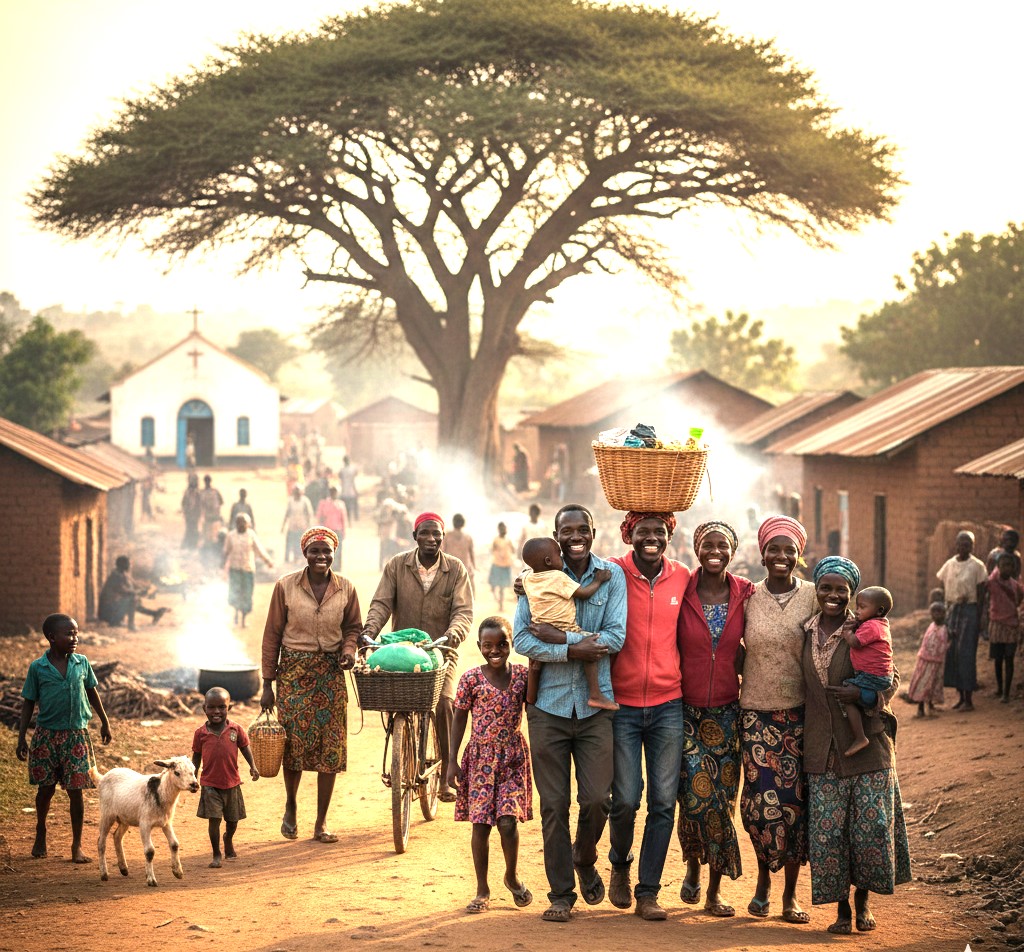
The Heartbeat of Togetherness: Ubuntu and the Sacred Home Return
In the fast-paced rhythm of modern African life, where careers and education often pull individuals toward bustling urban centers like Kampala, Nairobi, or Dar es Salaam, there remains an invisible, unbreakable thread pulling them back to the soil of their ancestors. This is not merely a matter of nostalgia; it is the living embodiment of Ubuntu—the profound African philosophy that “I am because we are.”
- Modern Relevance: In an era of globalization and increasing individualism, Ubuntu serves as a “social safety net.” For the modern African, the city represents a place of production, but the village represents a place of restoration. Ubuntu prevents the psychological isolation often found in Western urban life by reminding the individual that their value is inherent in their relationships, not just their productivity.
The Great Home Return: A Journey of Belonging
As December approaches, transport hubs transform into chaotic scenes of reunion. Despite hiked fares and grueling journeys over unpaved roads, the mandate is clear: you must return to the village of your birth. In our society, building a life in the city is seen as a means to an end—a way to acquire resources—but the village remains the spiritual and cultural anchor.
- Modern Relevance: This “Home Return” acts as a redistribution of wealth. Money earned in the city flows back into rural economies through transport, local markets, and family support. It bridges the “urban-rural divide,” ensuring that the prosperity of the capital city trickles down to the most remote homesteads.
The Risk of Disconnection
To stay away during Christmas without a grave reason is to risk your very sense of belonging. The community asks, “Has he forgotten us?” or “Has she lost her way?” Bringing one’s city-born children back to the ancestral land ensures that the next generation understands their lineage, keeping the flame of tradition alive.
- Modern Relevance: For the “digital native” generation growing up in cities, this return is a cultural orientation. It combats “identity dilution” by grounding children in their mother tongue, ancestral stories, and a sense of history that a screen cannot provide. It ensures that even in a globalized world, they have a “home base.”
The Feast of Ubuntu: Sharing Beyond the Fence
Once the “sons and daughters of the soil” arrive, the atmosphere shifts into one of collective joy. The essence of Ubuntu—humanity toward others—is served on every plate through specific rituals of radical hospitality:
- Abundance for All: Families do not merely cook for their households. The slaughtering of a goat or cow is a sacrificial act of communion; the animal’s life is honored by feeding the entire ridge, not just the nuclear family.
- The Open Door: On Christmas Day, fences are symbolic rather than functional. Carrying baskets of matooke, pilau, or nyama choma to neighbors reinforces the idea that hunger in one house is a shame to the whole village.
- The Communal Cup: Shared drinks (like Marwa, tonto or busera) signify trust. Drinking from the same pot or circle symbolizes that there is no “poison” or ill-will between neighbors, mending any rifts that occurred during the year.
Modern Impact: In a world of gated communities and digital barriers, these feasts are a masterclass in conflict resolution. It is difficult to maintain a grudge against a neighbor who has just shared their best harvest with you.
Reconnecting Through Faith and Heritage
The local church during this season becomes more than a place of worship; it is the ultimate community town square. While the birth of Jesus is the catalyst, the pews are packed because it is the one time of year the entire “family tree” is gathered under one roof.
- Modern Relevance: This is where mentorship happens. Successful professionals (doctors, engineers, entrepreneurs) sit in the same pews as village youth. These interactions provide the youth with tangible role models and social capital, while the elders provide the “city folk” with moral grounding and ancestral wisdom.
Solidarity in Sorrow and Joy
The strength of African togetherness is perhaps most visible in its consistency. The same community that gathers to feast during Christmas is the same community that rallies when a member passes away. Ubuntu dictates that we do not grieve alone. To be present at a funeral is to say, “Your loss is my loss; your burden is our burden.”
- Modern Relevance: This collective mourning is a powerful psychological buffer. In many parts of the world, grief is a private, lonely affair. In the spirit of Ubuntu, the “death of a neighbor” triggers a communal response that provides emotional and financial support (harambee), ensuring that the bereaved are not crushed by the weight of their loss.
Conclusion: The Unbroken Circle
Our cultural perspective on togetherness reminds us that we are part of a vast, interconnected web. Whether through the sharing of a Christmas meal or standing together in times of grief, the spirit of Ubuntu remains our guiding light. It teaches us that our roots are not just where we come from, but the very foundation that allows us to reach for the sky.
Understanding the Concept (The “What”) These questions ensure everyone is on the same page regarding the core philosophy.
- Defining Ubuntu: Based on this article, how does the African definition of “identity” differ from the Western individualistic view?
- The Spiritual Anchor: Why is the village considered the “spiritual anchor” while the city is just a “means to an end”?
- The Language of Food: In the section “The Feast of Ubuntu,” what do the acts of slaughtering livestock and sharing open baskets of food symbolize beyond just a meal?
Personal Reflection (The “Me”) These questions help to connect the article to your own lived experiences.
- The “Sacred Pilgrimage”: If you live away from your ancestral home, what emotions or pressures do you feel when December approaches? If you stay in the city, how does it change your perception of the holiday?
- Generational Gaps: For those with children born in the city, what are the biggest challenges in “keeping the flame of tradition alive” when you take them back to the village?
- The Weight of Success: The article mentions that success is measured by “willingness to pour it back into the community.” Have you ever felt this as a “burden of success,” or do you see it strictly as a “joy of giving”?
Modern Application (The “Now”) These questions explore how these traditions survive or change in a digital, globalized world.
- Digital Ubuntu: In an age of WhatsApp groups and Zoom, can the spirit of Ubuntu be maintained virtually, or is the physical “return to the soil” irreplaceable?
- The Economic Bridge: Discuss how the “Great Home Return” in December acts as an informal economic system. What would happen to rural economies if people stopped returning home?
- Social Safety Nets: How does the communal response to grief (funerals) act as a form of “insurance” that modern corporate insurance policies cannot replicate?
Future Outlook (The “Next”) Critical thinking about the sustainability of these cultural pillars.
- Urban Evolution: As African cities grow larger and more permanent, do you think a “New Ubuntu” will emerge that is centered on city neighborhoods rather than ancestral villages?
- The “Forgotten” Individual: Does the pressure to conform to community expectations (e.g., “Has he forgotten us?”) ever hinder individual growth? How can we balance community loyalty with personal freedom?
Talking Points & Answer Key
1. Defining Ubuntu: Identity vs. Individualism
- Key Concept: In many Western philosophies (like Descartes’ “I think, therefore I am”), existence is internal. Ubuntu posits that existence is relational.
- Insight: Using the metaphor of a web, if one string is cut, the whole web loses tension. In modern Africa, this explains why a person’s “reputation” is often considered a family asset, not just a personal one.
2. The Economic Redistribution (The “Great Home Return”)
- Key Concept: The return home is the largest informal transfer of wealth in the region.
- Insight: Note that this isn’t just about cash. It’s about “Human Capital.” When an engineer or accountant goes back to the village, they bring knowledge—offering advice on building, farming techniques, or navigating government bureaucracy.
- Potential Debate: Is the “hiking of fares” by transport companies a betrayal of Ubuntu, or is it just the reality of supply and demand?
3. Cultural Preservation & The “City Child”
- Key Concept: Transitioning from “Global Citizen” to “Community Member.”
- Insight: Many children in cities grow up speaking English or Swahili as a first language. The December return is often the only time they are immersed in their mother tongue.
- Discussion Tip: “Can you truly know your culture if you don’t know the language of your grandparents?”
4. The “Open Door” vs. Modern Privacy
- Key Concept: Radical hospitality vs. the security of the “Gated Community.”
- Insight: In the village, a fence is often just a marker of property, not a barrier to entry. In the city, fences have electric wires.
- Challenge: How do we maintain the “open heart” of Ubuntu in a city where crime and safety make us want to lock our doors?
5. Solidarity in Sorrow: The Social Safety Net
- Key Concept: Harambee (Kenya) or Amabugo (Uganda)—the “pulling together.”
- Insight: In the West, if you cannot afford a funeral, the state handles it or you go into debt. Under Ubuntu, the community sees a “shameful burial” as a reflection on the whole village. Therefore, they contribute not just money, but their physical presence to cook, dig the grave, and mourn.
- Modern Context: Discuss how “M-Pesa” or “Mobile Money” has changed this—we now contribute to funerals via phone, but does that replace the need to be there physically?
The Urban-Rural Balance summarized
| The Urban Experience (The Work) | The Village Experience (The Soul) | The Ubuntu Connection |
| Focus on the Individual | Focus on the Collective | Success is shared. |
| Measured by KPIs/Salary | Measured by Character/Generosity | Wealth is for the “we.” |
| Transactions are Contractual | Transactions are Relational | Trust is the currency. |
| Noise/Stress/Isolation | Silence/Ancestry/Belonging | Recharges the spirit. |
Closing Thought: “Ubuntu is not a museum piece; it is a living, breathing software for human survival. As we build our cities and our technology, we must ask: Are we building them to bring us closer together, or to keep us apart?”
The Spirit of Ubuntu; Reflection on Togetherness, Heritage, and the Modern African Identity. “I am because we are; and since we are, therefore I am.” — John Mbiti
1. The Core Pillar: Ubuntu: Ubuntu is more than a word; it is a worldview. It reminds us that our humanity is inextricably bound up in the humanity of others.
- Key Lesson: My success is incomplete if my community is suffering.
- Modern Challenge: How do I stay “human” in a digital world that encourages us to compete rather than collaborate?
2. The Sacred Return (The Village Anchor): The journey “home” each December is not just a vacation; it is a re-alignment.
- The City: A place of doing (careers, building, earning).
- The Village: A place of being (identity, ancestors, roots).
- Reflect: Am I taking my children “home” often enough to ensure they know their story?
3. Radical Generosity: In the spirit of Ubuntu, wealth is not measured by what you have in the bank, but by how many people you can feed at your table.
- The Open Door: Sharing a meal is an act of peace-making.
- The Communal Cup: Trust is built through shared experiences, not just signed contracts.
4. The Social Safety Net: Ubuntu provides a “cradle-to-grave” support system that modern institutions often struggle to match.
- In Joy: We celebrate as a collective.
- In Sorrow: We mourn as one. No one should carry the weight of a funeral or a crisis alone.
Personal “Take-Home” Challenge: Choose one action to perform this week:
- The Call: Reach out to an elder in your village or family. Don’t ask for anything; just listen to a story.
- The Share: Prepare a meal or a small gift for a neighbor you haven’t spoken to in months.
- The Bridge: Teach a younger person one cultural proverb or a word in your mother tongue that explains a core value.
Final Thought: Our roots are not anchors that hold us back; they are the foundation that allows us to reach for the sky. As we navigate the 21st century, let us carry the village in our hearts, even when our feet are in the city.


 COMMUNITY BASED TOURISM DEVELOPMENT AT KITARA FOUNDATION FOR SUSTAINABLE TOURISM: Transforming Communities through Travel Partnerships. Email: kitararcc@gmail.com;