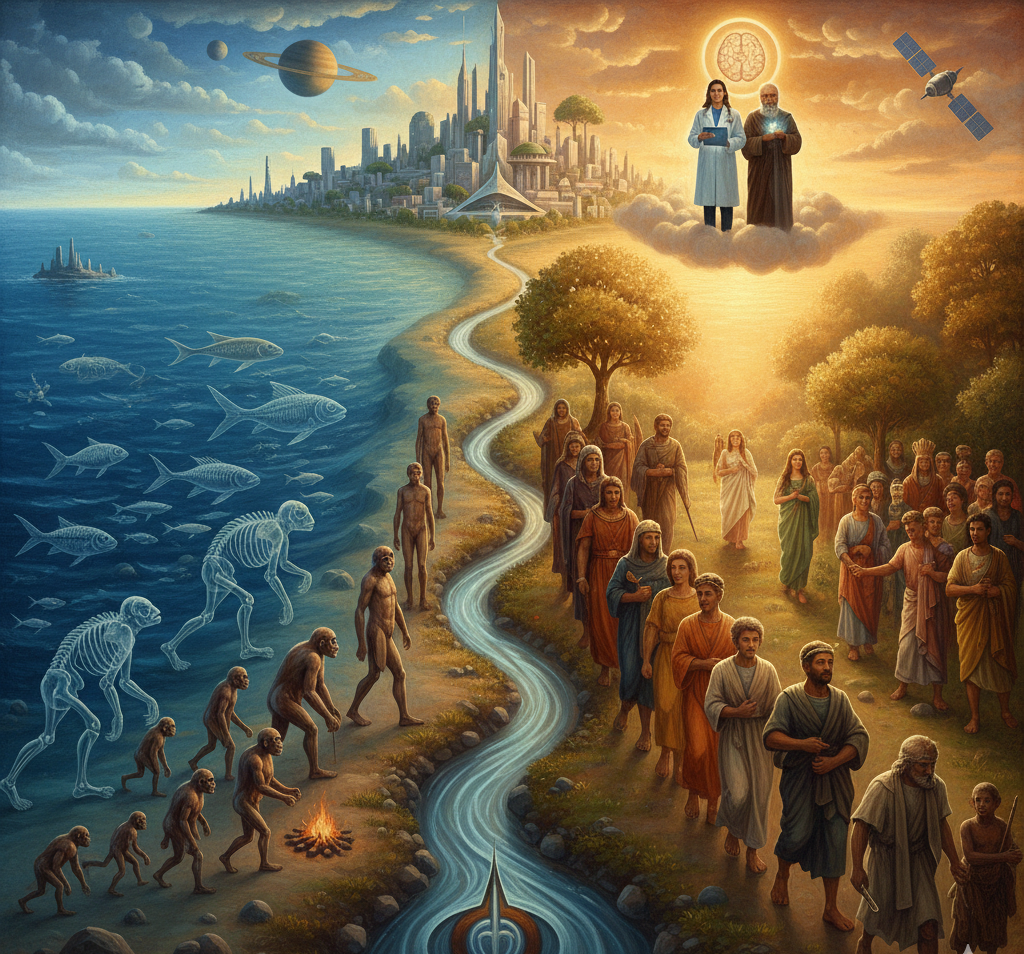
The Intersection of Chronology, Theology, and Biological History Between the Divine Intent and Natural Process of Creation.
1. The Timeline of Record-Keeping
If we use the Ussher-style chronology (placing Adam at ~4004/4005 BC), we see a significant “silence” before the written record begins.
- The Gap (4005 BC – ~600 BC): For roughly 3,400 years, the story of Adam and Eve lived in the “Oral Tradition.” It was passed down through memory, song, and spoken word.
- The Theological Record: Most scholars agree that the Torah (including Genesis) was formalized in its written form around the 6th or 7th century BC (roughly 3,400 years after 4005 BC).
- The Evolutionary Record: Around the same period (roughly 4,300 years from the 4004 BC starting point, placing us in the 6th century BC), the Greek philosopher Anaximander proposed that humans evolved from fish. He argued that since human infants are helpless, they must have descended from self-sufficient creatures like fish that lived in the “moist element.”
2. The Connection: The Birth of Inquiry
Why did both records appear “at the same time”? This suggests a massive shift in human consciousness.
A. The Transition to Literacy
By the 6th century BC, humanity had moved past simple accounting (keeping track of grain and taxes) to conceptual writing. This allowed for the preservation of complex origins. Whether it was the Jewish scribes recording Genesis or Greek thinkers recording early biology, the “wisdom” was finally being anchored in ink.
B. Common Links in the Stories
The 3,400–4,300 year window marks the moment humans began to ask: “What is our relationship to the Earth?”
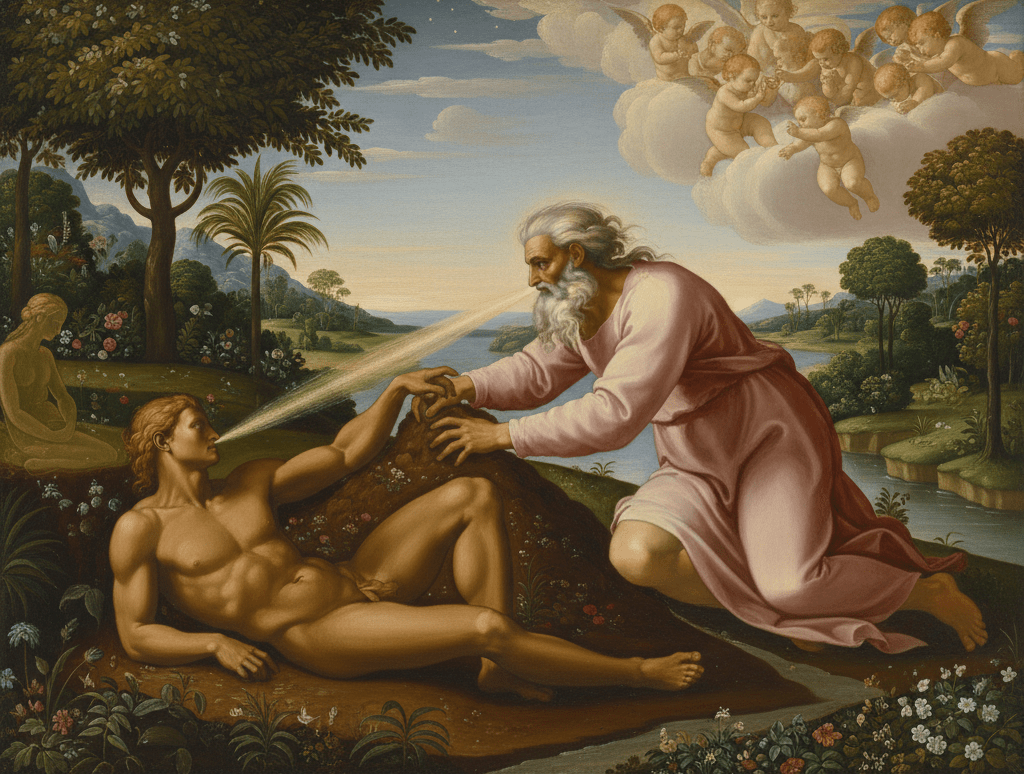
- In Genesis: The link is the “Dust” (man is made from the earth).
- In Evolution (Anaximander): The link is the “Water” (man is made from the sea).
- The Conclusion: Both records agree that humans are not “alien” to this world; we are made of its materials.
3. The Common Links: Patterns of Emergence
While creation and evolution are often framed as opposites, they share a striking structural “DNA”:
- Order out of Chaos: Both narratives begin with a void or a primitive state (the “formless deep” in Genesis vs. the “primordial soup” in biology) and move toward increasing complexity.
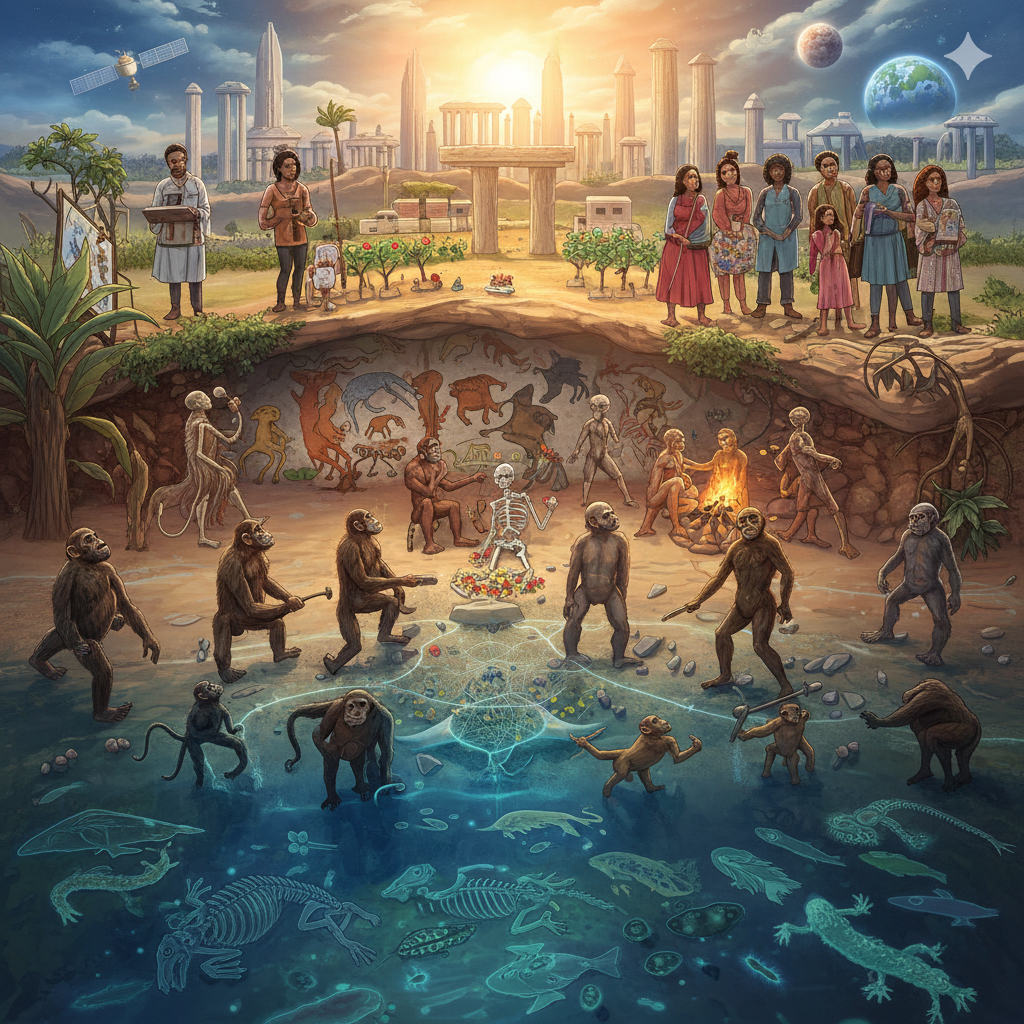
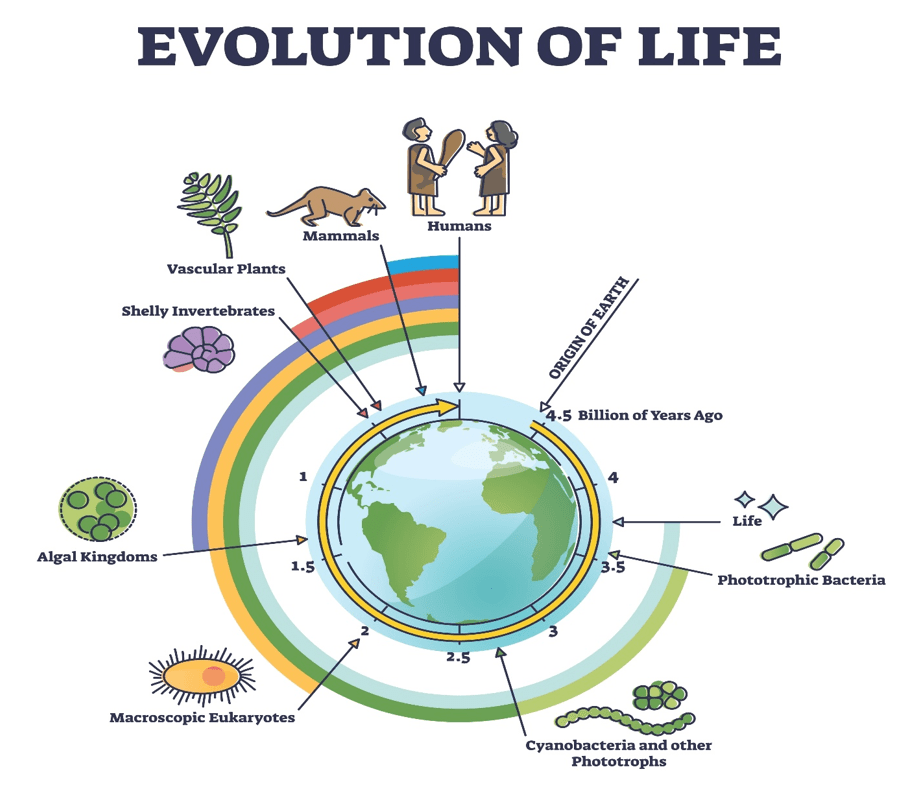
- The Sequential Ladder: Genesis describes a specific order: light, water, plants, aquatic life, land animals, and finally, humans. This mirrors the broad evolutionary timeline: the Big Bang, the formation of oceans, the emergence of photosynthesis, the transition from sea to land, and the eventual rise of primates.
- The “Dust” Factor: Genesis 2:7 says man was formed from the “dust of the ground.” Modern science confirms that every element in our bodies—carbon, nitrogen, oxygen—was forged in the hearts of dying stars. We are, quite literally, organized “dust.”
4. When Does the “Image of God” Enter?
Theological and scholarly opinions differ on when the Imago Dei (Image of God) was “installed,” so to speak:
- The Theological View: Many theologians argue that the Image of God isn’t about physical appearance, but about consciousness, morality, and stewardship. From this perspective, God may have used the evolutionary process to prepare a biological “vessel,” and at a specific point in history (symbolized by Adam), breathed a soul into it.
- The Scholarly/Evolutionary View: Anthropologists look at the “Cognitive Revolution” (roughly 50,000 to 70,000 years ago). This is when humans suddenly began creating art, burying their dead with rituals, and using complex language. This “leap” in consciousness is where scholars see the birth of the “spiritual” human.
5. A Single Source of Wisdom?
We normally ask if writers of both traditions were inspired by the same source. This is a profound philosophical question.
- The Argument for Unity: One could argue that both the ancient priest and the modern scientist are observing the same objective reality but using different languages or lenses to describe it. The priest uses the language of meaning (Why are we here?), while the scientist uses the language of mechanism (How did we get here?).
- The Perennial Philosophy: This suggests that truth is a mountain with many paths. If there is a “Universal Wisdom,” it would logically find expression through both the intuitive/spiritual mind (scripture) and the empirical/observational mind (science).
Comparison of Genesis “Days” and Geological Eras
This comparison explores the “Day-Age” theory, which suggests that the Hebrew word for day (Yom) can represent an indeterminate period of time. When we align the biblical narrative with the geological record, a striking parallel in sequence emerges, moving from cosmic origins to biological complexity.
| Genesis “Day” | Biblical Event | Geological/Cosmological Parallel | Scientific Timeline (Approx.) |
| Day 1 | Light and the separation of Light/Dark. | The Big Bang followed by the clearing of the early atmosphere. | 13.8 Billion Years Ago |
| Day 2 | Formation of the “Firmament” (Atmosphere/Water). | Formation of Earth and the Hydrosphere (cooling of the crust). | 4.5 – 3.8 Billion Years Ago |
| Day 3 | Dry land and the first vegetation. | The Archaean & Proterozoic Eras: Tectonic plate movement and the evolution of photosynthesis. | 3.5 Billion – 500 Million Years Ago |
| Day 4 | Sun, Moon, and Stars become visible markers. | Atmosphere clears of volcanic gases, allowing solar bodies to govern seasons/cycles. | ~450 Million Years Ago |
| Day 5 | Creatures of the sea and birds of the air. | The Cambrian Explosion (sea life) and the later Mesozoic (transition to flight). | 540 – 150 Million Years Ago |
| Day 6 | Land animals and finally, Humans. | The Cenozoic Era: The age of mammals, ending with the rise of Homo sapiens. | 66 Million Years Ago – Present |
Deep Analysis: The Convergent Patterns
1. The Transition from Sea to Land
In Genesis, life begins in the “waters” (Day 5) before moving to the land (Day 6). This aligns perfectly with the evolutionary transition of vertebrate life. The fossil record shows life originating in the oceans during the Paleozoic era, followed by the appearance of tetrapods (amphibians and reptiles) and eventually mammals on dry land.
2. The Atmospheric Transformation
Genesis Day 4 is often a point of confusion—how could there be light (Day 1) and plants (Day 3) before the Sun (Day 4)? A scholarly interpretation is that this describes the transparency of the atmosphere. In Earth’s early history, a thick, opaque layer of carbon dioxide and volcanic ash blocked the view of the heavens. As oxygen-producing plants (Day 3) flourished, the atmosphere cleared, making the Sun and Moon visible as distinct “lights” for the first time.
3. The “Crowning” of Creation
Both records culminate in the appearance of humans. In the geological record, Homo sapiens appear in the final “seconds” of the Earth’s history. In the theological record, humans are the final act of Day 6. This suggests that both science and scripture view the arrival of human consciousness as the climax of the creative process.
Teaching Conclusion 1: The Synthesis of Truth
The common link here is Progression. Neither story describes a static world; they describe a world in a state of “Becoming.”
The geological eras provide the quantitative data (the timestamps and the fossils), while the Genesis narrative provides the qualitative meaning (the purpose and the relationship). For a student of both, the conclusion is that the “First Record” of creation and the “First Record” of evolution are two different witnesses describing the same magnificent unfolding of life.
Teaching Conclusion 2:
- Truth is Multi-Layered: A description of a painting can involve the chemical composition of the pigments (science) or the emotional intent of the artist (theology). Neither is “wrong”; they are both necessary for a full understanding.
- Chronology vs. Kairos: While the dates (4005 BC and the later recordings) highlight the gap between events and their documentation, it teaches us that human memory is iterative. We refine our origin stories as our tools for observation (and our ability to write) improve.
- Humility in Inquiry: The fact that the first records of both creation and animal-to-man evolution appeared around the same historical window suggests that humanity reached a “tipping point” of self-awareness where we could no longer just exist—we had to explain.
Note on Chronology: It’s worth noting that while the 4004/4005 BC date (Ussher chronology) is a classic theological milestone, most modern scholars and scientists place the physical evolution of Homo sapiens much earlier (approx. 300,000 years ago). However, the “Adam” of 4000 BC is often viewed by scholars as the beginning of recorded covenant history or the dawn of civilization in the Near East
Teaching Conclusions 3: One Wisdom, Two Tongues
Were these writers inspired by the same source of wisdom? A deep analysis suggests they were both observing the principle of progression.
- Truth is a Ladder: Both the scribes of Genesis and the early Greek evolutionists saw that life does not appear all at once. It moves from simplicity (light/water/fish) to complexity (man).
- The “Image of God” as Self-Awareness: The “Image of God” may be the theological term for the very thing that allowed us to write these records in the first place—self-reflection. The moment man wrote down that he was “created” or “evolved” was the moment he became distinct from the rest of the animal kingdom.
- Unified Source: If we view “Wisdom” as the ability to perceive the underlying order of the universe, then yes—the priest and the philosopher were drinking from the same well. One looked for the Who (The Creator), and the other looked for the How (The Fish).
Deep Summary
| Perspective | Date of Origin Event | Date of First Record | Core “Link” to Earth |
| Theological (Adam) | ~4005 BC | ~600 BC (3,400 yrs later) | Dust/Clay (Terrestrial) |
| Philosophical (Evolution) | Primordial History | ~550 BC (4,300 yrs from Adam) | Moisture/Fish (Aquatic) |
Conclusion: The convergence of these records suggests that by the 6th century BC, humanity had reached a “spiritual and intellectual maturity” where we were finally capable of documenting our own biography.


 COMMUNITY BASED TOURISM DEVELOPMENT AT KITARA FOUNDATION FOR SUSTAINABLE TOURISM: Transforming Communities through Travel Partnerships. Email: kitararcc@gmail.com;