The House of Prayer for all Nations;
The House That Welcomes All: Reclaiming Unity in God’s African Family
When Christianity first touched African soil, a narrative often emerged from missionary circles – a perception that our motherland was a spiritual void, a “dark” continent untouched by the light of God. This viewpoint, and the actions that followed, struck many Africans as a blatant attempt to elevate Western values above our own, tragically used to justify the forceful takeover and exploitation of our lands. Missionaries were not just seen as introducing a new faith; they were often perceived as actively dismantling the very fabric of African culture, fueled by an arrogance that deemed their ways superior to ours. In this light, the missionary became, for many, an agent of colonization itself.
But the spirit of Africa is resilient. Our indigenous religious and cultural leaders rose to this challenge, initiating a powerful movement of resistance against this spiritual and cultural domination. For many Africans, the Westernized Christianity being presented failed to truly nourish their souls, leaving a profound emptiness. It had, in essence, taken away a spiritual framework that was deeply functional and interwoven with the very fabric of African life.
This initial encounter often framed Christianity and African culture as opposing forces, locked in a struggle for the hearts and minds of our people. The church was positioned on one side, and our cherished heritage on the other. Even today, some cling to this divisive view, perceiving a constant battle – a spiritual war in unseen realms that manifests in our cultural landscape.
This mindset can breed a rigid separation, discouraging Christians from fully engaging with their own society and culture. It risks portraying the Christian life as an escape from our African context, viewing those who celebrate and uphold our traditions as somehow being in opposition to God’s will.
However, this perspective fundamentally misunderstands the heart of African life. It too easily casts our own people as the “enemy,” rather than recognizing the universal human struggle against sin and the potential for God’s light to shine through all cultures.
At the Kitara Religious and Cultural Centre, we envision a different reality. We believe that cultural shifts, even those originating outside the church, are not inherently threats. God, in His infinite wisdom, has gifted all people – Christian or not – with the capacity to contribute good and valuable things to the cultural sphere. We believe that Christians who reflexively resist all cultural change may be missing opportunities to engage and offer a transformative perspective. While we acknowledge that not every cultural trend aligns with God’s values, and the church cannot simply mirror every fleeting movement, we also recognize the danger of isolating ourselves from the very people we are called to serve. Without God at its center, any culture can elevate idols – be it celebrities, political figures, the pursuit of wealth, or the allure of power.
The questions that guide us are crucial for the African church today: Can the church truly embrace the richness of African culture without also succumbing to its potential idols? Can we be deeply rooted in our African identity and still wholeheartedly practice the Christian faith?
Our answer is a resounding YES!
We believe that our African cultural context, with its deep sense of community, its respect for elders, its connection to the land, and its vibrant expressions of spirituality, is not a barrier to Christianity but a fertile ground for its growth. While we may discern aspects of our culture that need to be challenged and transformed in light of the Gospel, we largely see our heritage as an ally, not an enemy, to our faith. We recognize that positive cultural developments can be embraced and infused with Christian values.
We understand that God created a world where humanity would naturally create culture, and within that creation, we can often find echoes of truth, goodness, and beauty.
However, we also caution against a “Christianity of culture” that simply mirrors existing cultural norms without critical discernment. Our role as the church in Africa is not just to blend in but to be a prophetic voice, guiding our cultures towards Christ.
Christianity in and for Culture: Embracing Our Dual Heritage
Here at the Kitara Religious and Cultural Centre, we firmly believe that the most authentic and impactful way to live out our faith in Africa is through “Christianity in and for Culture.” This perspective empowers us to see ourselves as ambassadors of Christ, fully present within our African cultural context, living our lives for the good of our communities, and allowing our cultural expressions to be characterized by both obedience to God and a powerful witness to His love.
As Christians, we are indeed ambassadors of Christ (2 Corinthians 5:20). We represent a heavenly kingdom, a different way of life, even as we live amidst the realities of our African world.
We recognize that God created the very framework that allows culture to exist, to evolve, and to progress. As Africans, we shape and mold that culture within God’s divine design. We believe that every cultural context is structurally good – it is part of God’s intention for humanity. However, it can also become directionally corrupt, veering away from God’s path and towards the worship of idols.
Therefore, our calling as African Christians is to be fully immersed in our cultural contexts (structurally), while actively seeking to steer our cultural realities towards Christ, the ultimate source of truth and life, rather than towards the emptiness of idols (directionally).
As Christ’s ambassadors, we strive to understand our culture deeply – its languages, its customs, its values, and its longings. This understanding allows us to communicate the Gospel in ways that resonate with the African heart, showing how Christ is the ultimate fulfillment of our deepest desires for community, meaning, and spiritual connection.
We believe that every facet of African life and culture is ripe for Christian witness. Whether it is our art, our music, our family structures, our systems of governance, or our everyday interactions, every dimension of our culture is an arena where we can speak of Christ with our words and reflect Him with our lives. We give thanks to God for the richness of African culture and celebrate all that is good, true, and beautiful within it, while simultaneously seeking to redirect what is not good towards Christ and the holistic well-being of our people.
The Kitara Religious and Cultural Centre is founded on the understanding that culture and religion are inseparable forces in shaping the lives of individuals and the development of nations. “African spirituality simply acknowledges that religious beliefs and practices touch on and inform every facet of human life, and therefore religion cannot be separated from the everyday or mundane.”
For many Africans, the very notion of “religion” as something separate from culture, society, and environment is a foreign concept, a product of European missionary thought. In our traditional understanding, faith is not compartmentalized; it is a way of life that permeates everything – our politics, our art, our marriages, our health practices, our diet, our dress, our economic systems, and even our understanding of death and the afterlife.
This is not to say that indigenous African spirituality represents a rigid theocracy. Rather, it acknowledges the profound interconnectedness of the spiritual and the material, the sacred and the everyday. For example, in many African worldviews, sickness is not merely a physical ailment but can also signify an imbalance in one’s social life or a disruption in one’s relationship with family, community, or even ancestors, who are often seen as spiritual guardians.
Jesus in Africa: Our Healer, Liberator, and Elder Brother
Understanding “Jesus in Africa” means recognizing how Christ is perceived and proclaimed within our unique cultural context. It means acknowledging the history of discrimination and separation and embracing a vision of black and white Christians coming together as equals within a shared African experience of faith.
In our Christological understanding, we affirm that Christ is indeed the healer of our land and our people, the liberator from all forms of oppression, our ultimate ancestor in faith, the mediator between humanity and God, our elder brother who understands our struggles, the crucified Savior who bore our pain, the head of the Church, the master of our spiritual initiation, and the Black Messiah who identifies fully with the African experience.
Within the vast arena of African culture and religion, there is an expansive space for Jesus to transform African life from within, respecting and engaging with our existing spiritual frameworks.
When we consider the relationship between Jesus and Africans, it is not just about what Jesus has done for us, but what He has done with us, walking alongside us in our journey of faith and cultural expression.
Jesus as Our Ancestor in Faith:
Many African cultures have deep respect for ancestors, viewing them as continuing spiritual presences. When Africans speak of dying – “going to one’s Fathers,” “going home” – it signifies a transition to the spiritual world, a realm as real as our physical one.
While God is the ultimate Originator and Sustainer of all life, including the living dead and spirits, our ancestors hold a place of honor and connection.
In this context, Jesus, through His death and resurrection, can be understood as our ultimate ancestor in faith. He has gone before us into the spiritual realm, paving the way for our own connection with God. His resurrection, witnessed by many, signifies His triumph over death and His continued spiritual presence.
Those who accept Jesus and participate in the sacraments of Baptism and the Eucharist are understood to be joining this spiritual lineage. Water baptism symbolizes death to our old selves and entry into the new life of the Spirit. Sharing in the Eucharist, the body and blood of Christ, can be seen as a sacred communion that connects us not only with Christ but also with the entire community of believers, both living and departed – a concept that resonates with the African practice of sharing meals with the living dead.
In Jesus Christ, the worlds of the living and the living dead intersect, offering a powerful framework for understanding salvation within an African worldview. Our calling is to transform and infuse our rich African traditions with the light and love of Christ.
Contextualizing Salvation in Africa:
Our approach to teaching salvation in Africa must be rooted in our own cultural understanding, not simply a transplant of Western theological frameworks. Just as the understanding of the Trinity has been contextualized within African thought, so too must our understanding of salvation.
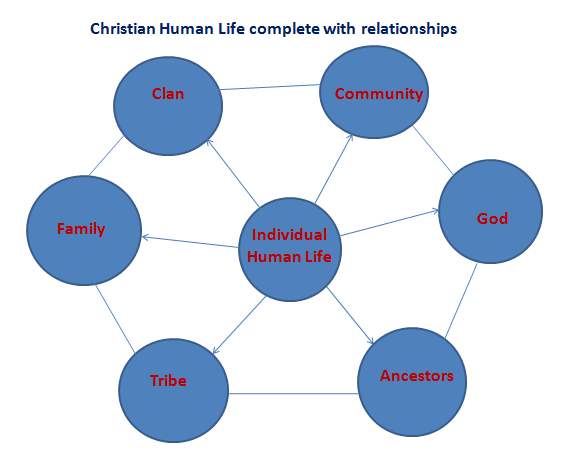
From an African perspective, life is deeply communal. Our individual well-being is intrinsically linked to the well-being of our community – our extended family, our clan, our tribe, our ancestors, God, and nature. Life is about maintaining and nurturing these vital relationships.
Our journey through life is often marked by “rites of passage” – rituals that guide us through different phases of development and connection. These rituals, encompassing life cycle events, crisis moments, and calendar celebrations, highlight the importance of community and relationship in our spiritual and social lives.
As Africans, we live within a dynamic web of communal interrelationships, where our lives are shaped and influenced by others, and we, in turn, influence those around us. We understand that life is not lived in isolation but in constant connection with the living and with the spiritual presence of those who have gone before us.
When faced with challenges, we often look beyond mere physical cause and effect, recognizing the interconnectedness of the spiritual and the material. In the traditional African worldview, there is rarely coincidence or accident; the spiritual realm is actively involved in our lives.
Salvation, therefore, is understood as wholeness – a restoration of broken relationships, whether with our community, our ancestors, or the spiritual realm, ultimately culminating in a harmonious relationship with God. Systems of oppression, such as imperialism and apartheid, were seen as forces that sought to shatter this wholeness, denying Africans their full humanity.
The salvation we seek must address the core concerns of the African people – the desire for well-being, healing, deliverance from evil, empowerment, fertility, and success in life. African Traditional Religion, in its essence, sought to achieve this ideal life through healing and cleansing rituals that restored all kinds of broken relationships.
Drawing from Liberation Theology and Black Theology, we understand that salvation involves liberation from oppressive systems and the affirmation of our full humanity as God intended. It is about finding relief and help in times of trouble, experiencing healing, driving away evil influences, empowering individuals, and fostering the flourishing of life in all its aspects.
African Traditional Religion has a vital space to exist within the Christian faith in Africa. It is not about replacing one with the other, but about finding a harmonious integration where the deep spiritual insights of our ancestors can enrich and inform our Christian worship. Our approach to God may differ in expression, but the fundamental yearning for connection with the Divine is universal.
The Living God: Experienced in Our African Reality
The concept of a God who is distant or uninvolved is foreign to the African spiritual experience. In traditional Africa, God is not a philosophical abstraction but an all-pervading reality, a constant participant in the affairs of human beings. Just as a Muslim invokes “insha Allah” and a Christian says “God willing,” the Akan of Ghana affirm that “all things pertain to God.” Nothing exists outside of God’s presence and influence.
This total dependence on God is evident in our prayers. God is the ultimate recipient of all supplication, and even traditional libations begin by invoking the name of the Almighty. This is the God who has been with Africans from the beginning, featuring prominently in our prayers, greetings, blessings, and even curses.
In African spirituality, it is not God who directly suffers from the evil we inflict upon one another; it is the individual who experiences the pain. However, when individuals suffer unjustly, God, as the Creator of all humanity, demonstrates profound concern. Behind every heartfelt plea for justice is the unwavering belief that God sees, judges impartially, and ultimately stands with the weak.
The immediacy of God in African life is also reflected in the very names we bear. Names like Byaruhanga (“everything belongs to God”), Kwarikunda (“if God wishes”), and Akampurira (“God heard me”) from Western Uganda, and Nyamekye (“gift of God”) and Dardom (“depend on God”) from Ghana, all speak to a deep-seated African ontology centered on God as the source of life, unity, and unquestionable sovereignty.
We experience God’s blessings when ideals like unity, community, caring, faithfulness, and excellence flourish among us, for in these virtues, we encounter the very essence of God.
God is experienced as the loving parent, the wise grandparent, a source of unwavering kindness and protection. Our closeness to God is often described in terms of the most intimate human relationships – motherhood and fatherhood. The existence of God was never a point of debate; the constant quest was to discern God’s active presence and work in our lives.
The African experience of God is that ultimately, God is on the side of the weak, the side of justice. We understand that no single perspective can fully encompass the mystery of God. Just as no single hand can cover the eye of God, Africans embrace a plurality of approaches and experiences of the Divine, recognizing that our understanding of God often varies according to the circumstances of our daily lives.
Building Up Christ’s Body in Africa:
How do these rich African experiences of God relate to the building up of the Body of Christ in Africa? How do our churches respond to the deep-seated spiritual understanding of our people? We are witnessing a powerful revival of traditional African images of God, particularly within the African Indigenous Churches (AICs) and, to a significant extent, in the “Prosperity Christianity” that has swept across Africa in recent decades.
This resurgence reflects a yearning for a Christianity that truly speaks to the African soul, one that acknowledges and integrates the profound spiritual wisdom of our heritage. The challenge for religious leaders in Africa today is to embrace this holistic understanding of faith, to move beyond the divisions of denominations, and to build a united church that reflects the inclusive love of God – a house of prayer truly for all nations, tribes, peoples, and languages, standing together before the throne of grace. It is time to dismantle the walls of division that were often erected by external forces and to celebrate the beautiful tapestry of faith that emerges when the heart of Africa meets the heart of Christ.
 COMMUNITY BASED TOURISM DEVELOPMENT AT KITARA FOUNDATION FOR SUSTAINABLE TOURISM: Transforming Communities through Travel Partnerships. Email: kitararcc@gmail.com;