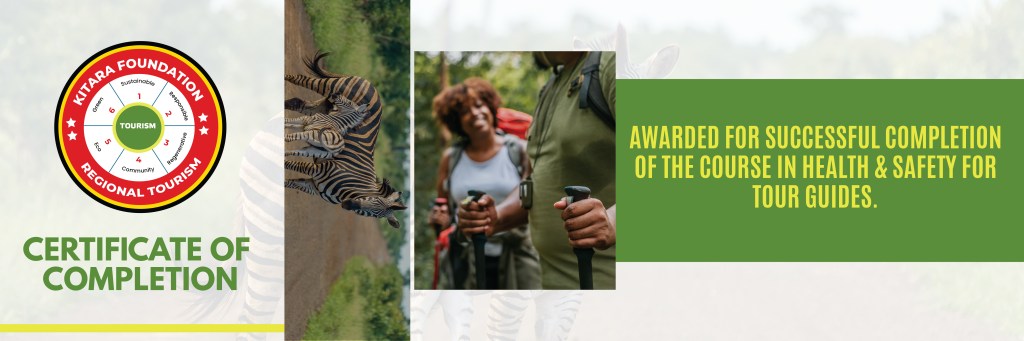
Health & Safety for Tour Guides
In this course, tour guides and prospective tour guides will get introduced to essential health and legal requirements. You will further learn how to manage health, safety and risk while guiding.
Who is this course for?
The course is intended for tour guides and prospective tour guides and anyone interested in the topic.
What will you learn?
- You will get an overview of health and legal requirements for tour guiding
- You will learn about the importance of assessing potential risks
- You will learn how to manage health emergencies and crisis while tour guiding
- You will learn how to cope with pandemics and epidemics.
Introduction to Health & Safety for Tour Guides
In this section, you will get an overview of health and legal requirements for tour guiding.
Lesson 1: Introduction
Description
Welcome to the fifth learning unit. In this learning unit, we’ll address a topic close to my heart, namely our health and safety as tour guides. This is not only an important topic, but also a complex one because it covers so many different facets.
First of all, of course there’s our own health. When we lead a tour, it’s important that we take care of ourselves, both mentally and physically. On top of this, there are also various legal requirements and responsibilities that we need to take into account. For example, we’re obliged to comply with the health and safety rules of the tour companies. These are aimed at protecting both us and our guests. Because, needless to say, as tour guides we also have a responsibility towards our guests.
In order to manage all this, we have to know exactly what the specific risks are and conduct an appropriate risk assessment. Only then can we react adequately to possible emergencies or crises. Our work can be further complicated by epidemics or pandemics, such as the current coronavirus pandemic. I’ll also go into this in more detail.
So, you can expect a learning unit full of relevant and important topics. I’m glad you’re joining us. Let’s get started right away.
Health Requirements and Legal Requirements
Lesson 1: Take care of your own health
We as tour guides interact with a variety of different people during a tour; working long hours every day. A robust physical and mental strength is prerequisite for this role. Furthermore, it is crucial that we pay special attention to our own health whilst on tour.
We must remain healthy and mentally stable
- as we are the main person in charge of the group
- in our own interest, e.g. not to overstrain and exhaust ourselves and to draw boundaries
If tour guides are not performing at their best, it will impact on the whole tour experience.
Employer-related health and safety requirements
Tour guides can also be employed by a company which pose certain requirements for employees regulated by protocols and employment law. In order to comply to employer-related health and safety requirements, tour guides need to familiarise themselves with those protocols.
Recommendations
I’ve been thinking here about some advice I’d like to share with you from my own experience. All of them are intended to keep you physically and mentally well and to protect you against illness or burn-out while you are on tour.
1. Get some You-Time
Observe safe health practices
Get plenty of rest, adhere to healthy and nutritious food intake, wear suitable clothing according to weather conditions, plan foresightful in advance in particular with regards to time management, e.g. plan in breaks.
Rest and switch off
Listen to music, read a book, take a walk or time for active sport, relax with a hot bath or mediation. Ensure you get enough sleep, late nights and early mornings are draining.
Training opportunities
Use professional development and training opportunities between tours or during “off” season: this boosts job prospects and self-confidence.
2. Protect your most important tool: your voice
Protect your voice, as this is your most important tool. Utilise microphones in the coach or PA systems, avoid smoky or dusty environments, measure and limit the use of your voice, plan ahead for talking duration, volume control, voice projection and location to avoid ambient noises and visual disturbances.
3. Look After Yourself
Hydration
- Ensure constant hydration (use appropriate and safe liquid, e.g. bottled still water)
- Beware of alcohol, excessive eating or drugs – everything in moderation
Clothing
- Always wear appropriate clothing suited to weather conditions and activities
- Wear rain gear or sun hat, scarf for protecting voice, wear appropriate and comfortable foot wear (protective socks, cushioned inserts etc.)
- Different activities require different equipment and protective needs (head coverings in mosques or churches, back pack and solid foot wear for hiking etc.)
Safe lifting
- Practice safe lifting techniques when handling baggage
- Use trolleys, lifts or call for assistance
4. Nurture your social environment
- Stay in contact with family members and friends from home or colleagues and locals whilst on tour, try to maintain social interactions outside the group.
- Keep complaints and difficult guests at a healthy distance.
After these recommendations from me, it is now your turn. You can plan and prepare some things in advance of the tour. These two tasks will help you to do so.
- Draw your own health requirement plan: How much sleep do you need each night? Any special dietary requirements or pre-existing medical conditions, any medication needed? Do you have family members or friends for mental support whilst on tour?
Which activities do help you to relax?
- Assess your company’s health and safety requirements, what are the requirements you would need to comply to?
Lesson 2: Legal requirements
Legal Health and safety obligations and responsibilities is a very important topic. This is because both the tour company and the tour guide themselves have responsibilities in this regard. I organised a webinar on this topic with Florian Dukic. He is an attorney at law and managing partner at Noll | Hütten | Dukic Rechtsanwälte, one of the leading law firms in Germany specialising in advising members of the travel industry on German and European travel, consumer and commercial law.
Discussion:
[Presenter] Welcome to a new expert interview. This time, I’m joined again by Florian Dukic, our expert on all legal issues. As you know, tool guides and tour operators, just like any other company, have certain responsibilities when it comes to health and safety, and that’s exactly what we’re going to talk about today. So let’s get going with the first question: in which fields of business are health and safety particularly relevant?
[Florian Dukic] Well, that depends of course on the individual business. But if you have offices with employees working in those offices, you may want to ensure and make sure that those offices are safe for those employees to be used. Moreover, if you have a store, with clients coming to those stores, of course it’s important that those stores are safe to be used and to be accessed by general members of the public.
[Florian Dukic] Given that you are a tour guide, most importantly, your tour guiding services need to be safe. And therefore, you will have to make sure that depending on what you’re providing, those tour guiding services are being provided on a very safe basis.
[Presenter] OK, great. So now we know a bit more about the responsibility of businesses, but what about the responsibilities tour guides carry? For example, when conducting a guided tour, what do they need to think about in terms of health and safety?
[Florian Dukic] Well, as I just mentioned, a safe tour is very important and it’s important that you take a deeper look into what you are providing as a service, as a guided tour. And the health and safety regulations and health and safety measures that you would need to take very much depend on what risks pertain to those tour services that you offer.
[Florian Dukic] For example, if you provide hiking tours on nature trails, there may be certain risks on the way. You would know what those risks are because you know those trails. You are, in the end, the person who is guiding the tourists across those trails. So you would want to identify those risks and then to take certain measures in order to mitigate those risks.
[Florian Dukic] If you’re offering game driving or hiking trails, hiking tours in in game regions, of course you would have to take more drastic measures in order to meet those risks and address those risks that are pertaining to game hikes. You would want to have armed rangers with you, who could, if a wild animal crosses your path, react. And those armed rangers, of course, would need to be properly equipped the one hand, as well as properly trained as well, in order to meet any situations that you may come across.
[Florian Dukic] If you are simply guiding someone through a city, then the risks may be less and less drastic and of course then the measures need to be less drastic as well. If, for example you have elderly persons, you may want to avoid leading them through a city during the heat of noontime.
[Presenter] We’ve now got a very good overview of what needs to be taken into account. My final question is: Why is “health and safety” so relevant for tour guides from a legal point of view?
[Florian Dukic] Well, it’s so relevant because it’s a central element of your service. If you cannot guarantee or ensure that the services that you are providing are sure and safe, then, of course, your clients, whether they be private clients or commercial clients, will be reluctant to book your service. Hence, depending on what your service is and hence, on what the level of danger and risk is, you will want to have a safety and health protocol in place in order to meet those requirements.
[Presenter] Thank you very much for your insights, Mr Dukic. It’s been really interesting talking to you. Thank you also to our viewers for watching. I hope you’ve learned a few things. I certainly have.
Company health and safety
There are legal requirements for institutions and organisations in maintaining health and safety procedures in the workplace. Legal obligations for employers vary depending on the country and its specific legislation. Most organisations are legally obliged to provide:
- A workplace that is without risk to health, safety and welfare
- Safe and adequate machinery, equipment and substances
- Appropriate plans, procedures, work methods
- Suitable instruction, information, training and supervision
- Adequate resources, including qualified personnel
Tour Guides’ health and safety
Tour guides, as employees or self-employed, must strictly comply with the companies’ health and safety regulations in order to make sure that customers are safe and safety standards are met. Tour guides are accountable for:
- Following strictly all safety procedures and instructions set out in the company’s health and safety regulations
- Always working in a safe manner
- Managing risks by conducting a risk assessment and communicating risks to customers
- Never carrying out a task which is dangerous or might put customers or themselves in danger
- Using safety equipment when required
- Reporting accidents and injuries, even if they are minor. This includes complying with reporting procedures.
Some companies request additional health and safety preconditions from tour guides prior to employment such as health certificates, first-aid training, etc.
Legal requirements can be very diverse in different countries and travel companies also have varying requirements. So you need to be prepared. These two research tasks should give you a start.
- Find out the legal requirements for health and safety in the workplace in your country.
- Research your company’s health and safety regulations. What obligations do you have to fulfil to meet pre-employment requirements? Write down a check list.
Health, Safety and Security
Lesson 1: Risks and their assessment
When travelling, accidents and incidents can occur. For us as tour guides, it is important to understand the risks a group and individuals might encounter whilst on tour.
I have compiled an overview of common risks with examples for you here.
When travelling, accidents and incidents can occur. For us as tour guides, it is important to understand the risks a group and individuals might encounter whilst on tour.
I have compiled an overview of common risks with examples for you here.
1. Medical issues
Medical issues of the tour guide and participants such as existing or chronic conditions, dental work, medications being taken, or allergies. Also includes access to medication and prescriptions.
Example:
- Customer with chronic heart disease forgets his medication and would need to retrieve a new prescription and medication.
2. Health risks
Health risks in the places you are visiting during the tour, including the availability of health care, vaccinations required, and rescue possibilities.
Examples:
- During a visit to historical monument in the midday sun, customer suffers dehydration and sun stroke.
- Customer trips and falls while visiting historical town with cobbled streets and steep steps….
3. Reputational risks
Reputational risks to the Tour Guide, Tour Operator, or other service providers such as coach companies and attraction providers.
Example:
- A customer complains about the tour guiding service and the quality of the tour in general by public review in the internet without communicating his dissatisfaction with tour guide during tour…
4. Security risks
This includes personal safety, the safety of baggage, as well as the possibility of unrest in the region(s) visited.
Example:
- Customer notice that her handbag is missing after she accidently left it in a café.
- Two young guests were attacked after a night out in the local pub….
5. Travel risks
This includes the availability of travel, its reliability (possible delays) and likelihood of accidents.
Example:
- When group reaches ferry port where crossing has been booked, the ferry has been cancelled due to poor weather conditions.
6. Accommodation risks
Quality of accommodation or the likelihood of it not being available e.g. due to overbookings or building work).
Example:
- Customer notices mould in bathroom after checking in to his/her room.
- On arrival at the hotel, there are not sufficient rooms available for all guests due to unforeseen building work/water leak…
7. Risks associated with the activities being undertaken
Risks associated with the activities being undertaken can range from building work whilst visiting historical monuments, hiking, mountaineering, or dancing etc.
Examples:
- During a visit of an archaeological site, a customer falls over a site-protecting scaffolding.
- Tour guide trips over a rock on a coast path hiking trip…
What is it like in your country? Reflecting on risks is important and serves prevention. That’s why I’ve come up with two tasks that you can use as a starting point.
- Identify 5 most common risks to health and safety whilst on tour.
- Describe examples where you encountered/where faced with those risks when guiding.
Risk assessment
Planning for and understanding how to manage risks arising from unforeseen events are key elements in tour guides’ responsibility to mitigate negative effects of situations whilst on tour.
Risk Assessment
A risk assessment establishes the steps to be taken in case of accidents or emergency situations. The development of the plan follows a clear process, ensuring that all stakeholders know what it involves.
START
Step 1: Establish the context
Find out policies, systems, procedures and relationships with main stakeholders, i.e. tour operators, coach companies, accommodation and attractions providers to be fully aware how they evaluate risks and deal with emergency situations.
Step 2: Identify the risks
In-depth risk analysis: What could happen at which stage of the tour? What might have happened in the region or tour in the past? Include events which could be a possibility, based on your knowledge of destination. Research historical events or consult an expert of the region.
Step 3: Analysing and evaluation the risks
Determine the likelihood of possible occurrence and consequences, from insignificant to catastrophic. For each identified risk, create a matrix using scores. Also considering levels: macro/global > no influence at all, meso/regional > limited influence, micro/local > you can take action.
Step 4: Treat risks
Different strategies to treat risks: Avoid risks > not proceeding with an activity; Reduce risks > implementing health and safety procedures, provide safety equipment etc.; Transfer risks > to third party, i.e. insurance company; Retain risks > accepting minor risks and manage them in most appropriate way.
Step 5: Monitor and review
Risks, current procedures and analysis should be reviewed on a regular basis. As circumstances and situations can change, so should the plan to be flexible and dynamic.
Communicate risks and risk management strategies
Tour guides communicate key messages about possible risks and risk minimising strategies with all stakeholders involved – tour organiser, staff, customers, suppliers – on an on-going basis before, during and after situations occur.
Key for an effective risk communication is, that tour guides remain factual, honest and reliable, and reassuring customers that possible risks have been taken good care of.
Let’s jump right in: Plan a 1-hour walking tour through your home town. Consider a group of 15 guests, varied age groups and abilities. In this context, the following three questions should help you to get started with the topic.
- Walk the planned route by yourself and observe the surrounding, record all possible risks.
- Conduct a risk assessment, analyse and score the risks, identify measurements to treat the risks.
- Discuss the risk assessment with a colleague.
Lesson 2: Procedures for health, safety and security
As you know, it is a legal requirement for tour guides to comply to regulations and procedures ensuring the health, safety and security of guests. This is not only important for the safety of tour guides and guests, but also to reduce the tour guides’ liability in the event of an accident or incident.
Communication with customers
We as tour guides should communicate all aspects of health and safety to the customers – prior to and whilst on tour. This includes not only making our guests aware of rules, but also informing and educating them about various safety issues and customs or rules of conduct in the country.
I would like to discuss the most important topics here.
Rules
Explaining health, safety and security regulations and emergency procedures, ensuring guests have understood and comply with procedures.
Explaining ground rules for duration of tour, including timings/departure times and individual requirement for punctuality, to stay on marked paths, avoid noise levels and disruptions in public places, etc.
Health issues
Health dangers
Pointing out possible health dangers related to tour and destination (e.g. strong sea currents, air pollution or natural weather occurrences, intense sun, malaria etc.).
Food
Food (allergies, translate local language for ingredients, be aware of food hygiene to avoid gastrointestinal disease and poisoning).
Health services
Health services (be aware of medicines and prescriptions, pharmacies and hospitals)
Preventative measures
Communicate preventative measures to avoid health risks (e.g. repel mosquitos, food poisoning > “Boil it, cook it, peel it or forget it”, sun burn or stroke, heat exhaustions, dehydration, wear scarf and warm clothes to avoid colds in airconditioned coach or restaurants etc.).
Safety issues
- Transport (seatbelt, stay seated, guard passengers as they embark/exit coach)
- Traffic (be aware of traffic rules, directing guests away from traffic)
- Accommodation (be aware of fire safety regulations, medical equipment/first aid on-site, tripping hazards)
- Attractions (tripping hazards, maps/directions for orientation/avoiding to get lost, medical/first aid provision on-site)
- In the field (stand behind yellow marking on platform, off the cliff edge etc.)
Security issues
THEFT
Avoid jewellery, avoid showing/leaving possessions visible, carry hand bag on averted side of road, be aware of children with boxes or bags in hand, trying to distract and steal.
ASSAULTS
Avoid certain streets or areas. Avoid going out in the dark. Tourists should walk in groups whenever possible and choose appropriate clothing according to cultural context.
NATIONAL/REGIONAL CONFLICTS
Avoid certain areas, be aware of emergency plans and procedures.
Etiquette and customs
Country/Culture specific rules
- Be aware of appropriate clothing and behaviour,
- Not allowed to take pictures,
- Not to enter sacred buildings/temples without head coverings,
- Not to drink alcohol or take drugs,
- Avoid approaching people etc.
National bank holidays
- Be aware of celebrations and customs,
- Respect traditions.
After all the information I’ve given you, it’s your turn again.
- Discuss the health, safety and security procedures established for tour guiding with a colleague.
- Discuss the implications of disregarding the health, safety and security procedures with a colleague. What would happen? Outline a “worst case” scenario.
Lesson 3: Health and safety aspects when traveling with elderly people
Senior citizens are strongly represented on round, hiking, cycling or hobby trips, long-term vacations and cruises. Reason for this is their abundance of time and financial resources.
But what points should tour guides consider when older people are travelling with a tour group?
Lesson
Tour guides should plan and adapt to the needs of elderly customers, in particular with regards to health and safety measures. One crucial aspect when planning for health and safety is considering the process of ageing and adapting to the needs of older people.
Elderly people may have limitations when it comes to short term memory. Meeting points and departure times need to be stated clearly and repeated often.
Assistance should be provided when transporting heavy luggage.
Increasingly poor vision and hearing, as well as circulatory problems are also common. Elderly guests should therefore be made aware of uneven floors or steps. More breaks with seating options need to be planned in.
Many elderly people also need to have regular access to a toilet, for example every 1 1/2 to two hours, sometimes even more often.
Information should be conveyed in small and easily understandable doses. Many elderly people find it difficult to absorb large chunks of information.
Certain activities may take longer than with younger guests. It’s a good idea to adjust the length of walks or hikes accordingly. Good time management is essential here.
Elderly people consume fewer calories and usually want to eat smaller portions. This can be stated right away in the restaurant. It also makes sense to make lunch the main meal rather than dinner.
If these points are considered, it is easy to also accommodate elderly guests and provide them with a very comfortable travel experience.
What to do?
Dealing with Prejudices
Elderly people often have preset attitudes to politics, religion, conventions.
Tour Guide Strategy: Showcase good manners, avoid certain topics. treat guests with care and respect.
Need for Communication
Since many elderly people live alone, they often have a greater need for exchange when they are on vacation, which for some is also expressed in speaking a lot (“logorrhea”), in frequent repetition, preferably old stories.
Tour Guide Strategy: Ensure that frequent speakers do not always sit in the same constellation at tables as conversations are difficult in their presence and other guests will be degraded to mere listeners.
Little Travel Experience
Some seniors possess little travel experience and are unfamiliar with English terms such as “e-ticket” or “voucher” and e.g. hotel key cards etc.
Tour Guide Strategy: While younger guests appreciate individual free time, many seniors require more support and all-round care, sometimes being afraid of spending free time alone. Tour guide can also provide suggestions for an evening outing in small groups, explaining public transport etc
Imagine the following situation: Two elderly guests in your group are walking very slowly, they require walking sticks.
- Plan a 1-hour city tour on foot. (Use your home town) Prepare a route and strategy so that the two guests as well as the group will be able to see the most important landmarks and places of interests.
- Develop alternative strategies for the group and the two guests, e.g. second tour guide or assistant, alternative mode of transports etc.
Lesson 4: Dealing with health emergency situations
Illnesses, incidents or accidents lead to emergency situations, affecting the whole group and endangering the success of the tour. Tour guides have to manage emergency situations quickly and professionally in order to ensure the successful continuation of the tour.
Within organizations, definitions of and response to an emergency situation can differ. It is important that tour guides know and follow company specific procedures for dealing with emergency situations.
Dealing with health-related emergency situations
I have taken four of the most common health-related emergency situations and written down some procedures that you can and should follow as a tour guide.
Diarrhoeal diseases
Caused by different sources and bacteria in water, food or through poor hygiene, diarrhoea should be dealt with immediately to avoid spreading across the group.
START
Step 1: Separate affected guests
Separate affected guests from group and let them rest in their room. If on round tour, rearrange seating so guests sit close to coach toilet. If possible, keep seats around free.
Step 2: Practice safe hygiene!
Disinfect luggage, items and coach with which guest has been in contact
Step 3: Locate source of infection
Try to locate source of infection. How many people are affected? What has been eaten/served in the hotel or restaurants. Write down a list of possible food or contact contamination.
Step 4: Contact tour organiser
Contact tour organiser and await further instructions. If guest is not fit for travel, alternative accommodation or transport has to be arranged.
Heat exhaustions and heat stroke
Common for guests from temperate climates and are not used to sun and heat in tourist destination.
Heat exhaustion can be dealt with self-care at home. Guests stay in cool, shaded area and drink plenty of fluids, apply water to skin, avoid drinking alcohol and caffeine.
Heat stroke is a life-threatening medical condition and requires immediate medical attention. Move guest in cooler area and give cool beverages to drink while waiting for ambulance.
Serious illness of passenger
It happens that guests also become seriously ill. You then have to adapt your response so that the sick guest gets help as quickly as possible and you protect yourself at the same time. I have summarised the most important points for you here.
1. Contact tour organiser
Contact tour organiser and provide information on:
- Name and home address of the customer.
- Hospital address and phone number.
- Department and name of the treating doctor, diagnosis.
- Name of the accompanying person or the address and telephone number of the next of kin
- Address of the insurance companies and insurance numbers.
2. Inform the group
- Inform the group.
- Communicate clearly procedures etc.
3. Seek medical assistance
- Seek medical assistance promptly, e.g. attend nearest hospital.
- Ask accompanying friend or relative to escort guest.
- If the guest was unaccompanied, ask driver to function as tour guide while you attend guest in hospital.
4. Practice safe hygiene
- Practice safe hygiene in particular if cause of illness is unknown.
- Wear gloves when blood is involved.
- Protect your health first.
5. Medical history of the guest
- Identify and ask friends and family members of the guest for medical history.
- Check for medicines, medical bracelets or search the bag for written medical information if there are no friends or family members (Some religions and cultures have peculiar regulations for health – abide by them).
- Check for medical insurance.
6. Cause of illness
- What is cause of illness?
- Write down symptoms or injuries.
- Note also time of day and attraction/sight you are at.
7. Contact tour organiser
Contact tour organiser and provide information on:
- Name and home address of the customer.
- Hospital address and phone number.
- Department and name of the treating doctor, diagnosis.
- Name of the accompanying person or the address and telephone number of the next of kin
- Address of the insurance companies and insurance numbers.
8. Inform the group
- Inform the group.
- Communicate clearly procedures etc.
Accident of a passenger
Now it happened! A guest had an accident. What now?
START
Step 1: Stay calm
Stay calm, use time efficiently!
Step 2: First aid
- First aid should only be delivered by a certified first aider (Precaution because of legal regulations, implication if person becomes terminal or death).
- Call (or enlist another group member to call) doctor or emergency service. If at an attraction with medical facilities, use them.
- Check for medical insurance.
- Note time of day and attraction/sight you are at.
Step 3: Practice safe hygiene
Practice safe hygiene (Wear gloves when blood is involved, protect your health first)
Step 4: Seek medical assistance promptly
Seek medical assistance promptly, e.g. attend nearest hospital. Ask accompanying friend or relative to escort guest. If the guest was unaccompanied, ask driver to function as tour guide while you attend guest in hospital
Step 5: Protect personal belongings
Protect personal belongings, papers and travel documents of the customer (passport, insurance documents, foreign exchange, visa, other documents)
Step 6: Inform the group
Inform the group and communicate clearly procedures etc
Step 7: Contact tour organiser
Contact tour organiser and provide information on:
- Name and home address of the customer
- Hospital address and phone number
- Department and name of the treating doctor, diagnosis
- Name of the accompanying person or the address and telephone number of the next of kin
- Address of the insurance companies and insurance numbers
- Further course of the trip and decision as to whether the guest can continue the trip, stay in hospital or have to be transported home
I know that of course we all hope that such situations do not occur. But you also know that I think we can prepare for many things in advance.
So here are two tasks for you.
- Research your organisations specific procedures for dealing with emergencies.
- Discuss with a colleague or friend what other health related emergency situations in your country/region can occur/or has occurred.
Lesson 5: Crisis management in Tour Guiding
Crisis – a definition
- Time of difficulty or danger, usually when difficult or challenging decision must be made.
- Can be in form of health threats (see 2020 global Coronavirus pandemic) or natural disasters, political unrest or terrorist attacks.
During the most severe emergency situations – i.e. crisis – tour guides must act promptly to manage the crisis successfully and professionally. In this lesson, I would like to outline the recommended steps to take in the event of a crisis.
For all situations, the tour guide has to stay calm and organised, communicating with stakeholders in a concise and factual way.
1. Participant is missing or in immediate danger
Safeguarding of customers is paramount. Variety of reasons why participant is missing, e.g. misunderstanding of meeting/departure times, decision to spend the day or evening individually without informing tour guide etc. However missing vulnerable customers might be at risk of harm.
What would you do if a participant is missing?
Step 1: Contact by mobile phone or friends ’phone (exchange of numbers advisable
Step 2: Locating last place of contact/waiting at last meeting point
Step 3: If no contact can be established, contact police and inform organiser
2. Participant being a victim of criminal incident
Depending on the severeness of the incident, a customer may require immediate help:
- Notify police and doctor (if injured)
- Record what happened, time and location of incident, possessions stolen, injured?
- If guest needs to be hospitalised, protect customers belongings/identify and instruct accompanying friend or relative.
- Inform organiser and discuss further steps/instructions.
3. Death of a passenger
The death of a customer is a major emergency situation whilst on tour and should be treated step-by-step as follows.
Step 1: Get help
Notify police and doctor immediately!
.
Step 2: Collect
Collect the deceased’s personal papers in the presence of a witness.
Step 3: Inform
Inform organizer (name, participant number, services booked by the deceased, time and cause of death, personal data) and await further instructions.
Step 4: Notify
Notify embassy or responsible diplomatic mission/embassy (translation of official documents such as death certificates, police documents, export permits for the corpse, etc. must be translated into a certified translation).
Think about that too!
Do not contact the relatives of the deceased independently, ask the organiser first. The death will also have an impact on the other participants and the itinerary, so take this into account as well.
Crises are an immense challenge for us as tour guides. We not only have to organise a lot, but also respond to the needs of the participants. And of course we must not neglect ourselves in the process. Needless to say, a crisis is always very individual, but nevertheless we can and should play through different scenarios in advance in order to be better prepared in case of an actual emergency.
- Play through the different situations of crisis with a friend or colleague, follow all recommended steps in the correct order. Nobody can prepare you (emotionally) for the death of a guest whilst on tour, but practicing the emergency procedures will help you to follow them in a situation of crisis.
- Research relaxation and/or breathing techniques which might help you to handle situations of severe stress. Practice them with a friend, relative or colleague.
Epidemics and Pandemics
Lesson 1: Epidemics and pandemics
Description
Epidemics and pandemics cause health related crises which can have a devastating impact on the travel industry. Unlike natural disasters or political unrest, the effects of epidemics and pandemics are cross regional or even global.
Between 2014 and 2016, the Ebola epidemic affected several West African countries and impacted on tourism elsewhere in Africa.
The current global COVID-19 crisis has deeply affected the economies worldwide and as a result, 2020 saw a 60 to 80% decline in international tourism.
For the tourism industry, this includes loss of jobs and revenue, a lack of business and general insecurity about the future
Recovery of the tourism industry
Paralysing the global economy on an unprecedented scale, it is uncertain what the long-term implications of COVID-19 will be. How quickly the tourism industry will be recovering depends on a variety of different factors:
Time
How long will the pandemic last? When will a treatment or vaccine become available?
Travel restrictions and lockdown measures
When and how will countries start easing restrictions? What local/regional travel warnings and quarantine measures will be issued?
Consumer confidence
How long will it take for consumers to feel confident and to reassume travel? How will travel behaviour change? Domestic or international travel? How will social distancing rules impact on travel?
Economic impact
How deep and how long will the global recession be? How much will customers be able to spend for travel in the future? What economic impact has the crisis on service providers in destinations worldwide?
Governments measures
How do governments across the world support tourism? Ease of restrictions, imposing of new restrictions? What financial aid packages or funding opportunities will be provided? Small and medium scale businesses?
What impact has and has had the COVID-19 pandemic in your country?
- Identify the risks of COVID-19 in your destination. Conduct your own research about the impact and current situation using sources such as your government, Ministry of Tourism, national tourist board and tourism associations.
Lesson 2: Guiding and Epidemics -COVID-19
Tourism industries across the world drafted safety protocols for re-opening businesses under COVID-19 regulations. In order to minimize the risk of COVID-19 infection, tour guides must apply safety guidelines in accordance with tour organizers’ policy. This includes:
- The development of a COVID-19 emergency plan in addition to risk assessment.
- Allocation of additional resources, i.e. Personal Protective Equipment (PPE) and hand sanitizer.
- Development of action protocol in event customers show COVID-19 symptoms.
- Compliance with guidelines issued by health organisations.
COVID-19 emergency plan
Four areas must be included in the COVID-19 emergency plan. I would like to discuss the four areas in more detail below.
1. Adapting tour guiding activities
Gain information
- Gain information and training on health and hygiene risk prevention for activities.
- Research health and hygiene protocols of local service providers (accommodation, restaurants, coaches, museums, etc.) in advance
Prepare
- Prepare how visits will be conducted based on risk assessment and restrictions/regulations of attraction providers e.g. museums, monuments etc.).
- Prepare walking tours and stops in open/wide spaces respecting safe distance. Plan one-way-routes in small towns, and avoid crowded areas and small places with limited capacity.
Establish
Establish maximum number of customers (in accordance with tour organiser). Driver guides to follow guidelines by health authorities.
Choose
Choose restaurants where customers can sit outside or safe distancing is ensured inside.
2. Tour briefing and information
In order to make participants aware of the hygiene measures, you should send out health and safety documents before the start of the tour (preferably in customers mother tongue and graphic/illustrated). You have to communicate restrictions to the participants and also make sure that they are respected by the participants. If someone does not abide by the rules, the travel contract must be cancelled.
3. On tour
Prevention:
- Recall preventative measures and urge customers to comply.
- If tour guides experience COVID-19 symptoms, they should refrain from service immediately.
- Use PA system and microphone, use disposal cover for microphone.
- Comply with cleaning requirements, e.g. disinfectant product, frequency, used equipment, vehicle if driver guide.
Protection:
- Wear a mask or protective shield when safe distance cannot be guaranteed/for hearing impaired customers.
- Dispose of used protective materials (gloves, masks) and personal hygiene waste (tissues) in authorised waste bins immediately.
- Wash hands frequently with soap and water, when not possible use hand sanitiser
Avoidance:
- Avoid physical contact with customers at all times, always maintain safe distance between customers and colleagues.
- Avoid sharing equipment with customers and tour guides. Establish cleaning and disinfection guidelines if equipment is shared.
- Avoid printed material, e.g. brochures, pictures or objects.
- Avoid using cash, card payments when charging for services.
- Avoid improvisations to the planned schedule.
Corporation with service providers
- Send list of customer details in advance
- Set up appointments and time slots
- Staggered entrance to hotels, museums, monuments etc.
- Hand out room keys inside coach
- Transport guidelines for coaches: space between passengers, distance to driver, each passenger sits in same seat for duration of tour
- If possible, split group for entrances to reduce amount of people
So much from me on the subject of tour guiding during COVID-19. In order for you to be well prepared, I have three tasks for you here.
- Research COVID-19 test facilities and procedures (costs, how long for results?) in your area.
- Contact health authority and enquire about procedures in case of COVID-19 case within your group.
- Prepare an introductory speech how you would introduce new rules and measurements to your guests. Present to a friend or colleague.
You have successfully completed the fifth learning unit of the course “Digital Tour Guiding”. I look forward to seeing you again in the next learning unit.
 COMMUNITY BASED TOURISM DEVELOPMENT AT KITARA FOUNDATION FOR SUSTAINABLE TOURISM: Transforming Communities through Travel Partnerships. Email: kitararcc@gmail.com;