UNESCO Sustainable Tourism Tour Guiding: Artisans
In this course, artisan entrepreneurs will learn how to share about World Heritage, Living Heritage and sustainable tourism when selling their crafts to visitors. It will take you about 45 minutes to complete this course and you will earn an open badge if you reach a score of 80% or more at the end quiz.
Who is this course for?
This course is for artisan entrepreneurs who are willing to expand their local craft business sustainably. They will acquire an understanding of what is cultural heritage and why it is important to include and transmit tangible and intangible cultural heritage with visitors and customers.
This course was designed in a Blended Learning programme which can be complemented by a webinar and in situ training.
What will you learn?
This course introduces basic concepts of sustainable tourism, World Heritage, Intangible Cultural Heritage and how artisans can include these elements in their business and with customers. They will also be given tips on how to implement online and offline marketing measures and strategies.
Keywords
Artisans, artisan entrepreneurs, sustainable tourism, World Heritage, Living Heritage
Why Sustainable Tourism Matters
As an artisan entrepreneur in a World Heritage destination, tourism is probably very important for your business. When the COVID-19 pandemic hit and international tourism was restricted, you may have experienced a significant drop in your sales.
During the pandemic, many people debated how tourism should ‘build back better’ from the crisis. It was generally agreed that tourism needs to be more sustainable and that destinations should be better prepared to handle similar shocks in the future.
In this lesson, we will look at what sustainable tourism means and why it is important for artisans.
What does sustainable tourism mean?
The term ‘sustainable tourism’ has been used for more than four decades; however it is sometimes misunderstood. Often, people think it just means protecting the environment. However, it actually covers a very wide range of issues and topics in tourism.
The most widely accepted definition of sustainable tourism is: “tourism that takes full account of its current and future economic, social and environmental impacts, addressing the needs of visitors, the industry, the environment, and host communities” Source: World Tourism Organization (UNWTO)
Why is sustainable tourism important?
As an artisan entrepreneur in a World Heritage destination, you may have seen both positive and negative impacts of visitors on your destination. Tourism is important for many World Heritage sites around the world. It creates jobs and it brings income that can help to protect heritage sites. But it can also create problems as well when it is not managed carefully.
Understanding common definitions related to ‘sustainable tourism’
Many terms are often used alongside, or instead of ‘sustainable tourism’. They can be confusing. By using the correct definitions, tourist guides can help to improve visitors’ knowledge and spread understanding about the concepts related to sustainable tourism during their journeys.
Let’s take a look at some of the most common words in the sphere of sustainable tourism.
Responsible tourism
Aims to make better places for people to live in and for people to visit. ‘Responsible tourism’ focuses on the need to take responsibility for the impacts of tourism activity.
Ecotourism
Responsible travel to natural areas that conserves the environment, sustains the well-being of the local people, and involves interpretation and education.
Green tourism
Generally refers to tourism activity operating in an environmentally-friendly manner.
Community based tourism
Tourism experiences hosted and managed and/or owned by local communities which generate direct economic benefits. May also include social enterprises and other not for profit models designed to deliver benefits at a local level.
Regenerative tourism
This is a more recent and evolving approach. It places tourism as an integral part of a ‘living, networked system’. The aim is not only to ‘do less harm’ but to rejuvenate and nourish by building “economies and communities that thrive, and that allow the planet to thrive too.”
How does sustainable tourism relate to the Sustainable Development Goals?
The 2030 Agenda was designed as an action plan to ensure a sustainable future for all humanity. This vision is guiding the United Nations to transform the world by strengthening peace, eradicating poverty and ensuring a long-term transition towards sustainable development.
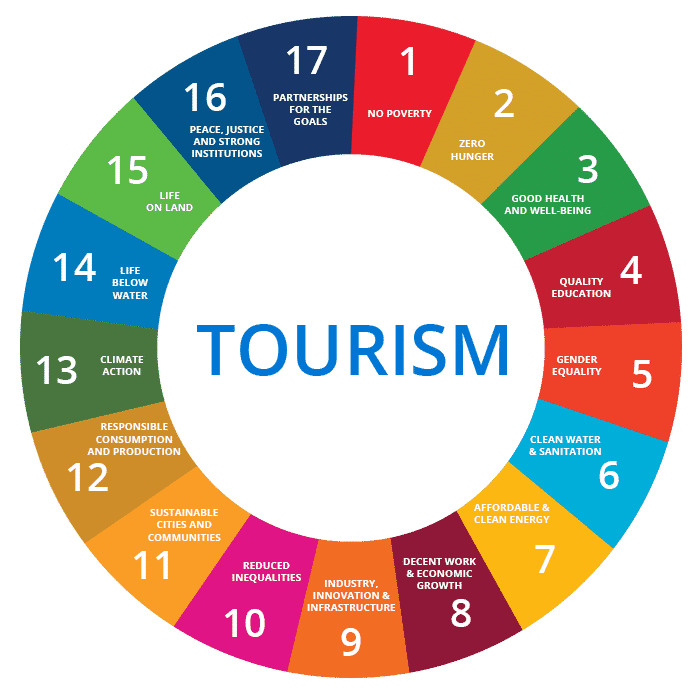
The wheel below shows the 17 Sustainable Development Goals (SDGs). Tourism can contribute to each of these. Let’s look at some examples:
Goals 8, 11, 12 and 13
Tourism has the potential to contribute to all SDGs, whether directly or indirectly. However, tourism has a special role to play in Goals 8, 11, 12 and 13. These goals are about inclusive and sustainable economic growth, the preservation of cultural and natural heritage, sustainable consumption and climate change.
What are some of the good and bad things about tourism where you live? Let’s look at a few examples of what can happen with increased tourism.
Whose Job is it to ensure that Tourism is Sustainable?
Everyone has a role to play in supporting sustainable tourism. That includes governments, businesses, tour operators, tourist guides, tourists… and you!
How does sustainable tourism work in practice?
Sustainable tourism practices are about planning, developing and managing tourism to:
- Manage and reduce the negative impacts of tourism, while increasing the benefits that tourism creates for places;
- Protect nature and biodiversity;
- Respect, celebrate and preserve traditions and heritage;
- Support local economies and create jobs;
- Improve the wellbeing and quality of life of communities, while involving them in tourism managed.
Source: Handbook on Encouraging Sustainable Tourism Practices / European Travel Commission, 2021
How can artisans support sustainable tourism?
Artisans are an important part of the tourism ecosystem. Your crafts appear in local hotels and restaurants. Visitors purchase your products as a way to remember their trip and share with friends and family back home. There are many ways you can help support sustainable tourism while improving your products and creating a positive experience for your customers.
Here are a few examples:
- Source your raw materials locally and work with local suppliers (avoid international shipping)
- Try to find more sustainable materials or resources to make your products
- Think about your product lifecycle. Is there a way to make your products last longer?
- Skip the product packaging where possible. If packaging is needed, use recycled/recyclable materials
- Reduce water usage in production
- Offer cultural experiences where visitors can learn more about your craft making
- Support local charities or environment conservation organizations
- Be part of a sustainable tourism association or cultural association/ NGO
- Sell products that locals will be interested in, not just international tourists
We buy over 80 billion new garments a year and consume 3.9 billion tons of food – a third of which is lost or wasted. Nearly one million plastic bottles are sold every minute, and five trillion pieces of plastic are floating in our oceans (Source: Consumers International)
Your role in the local community
As an artisan, your heritage products and services can support your heritage and community. When thinking about your role in the local community, it’s important to look at:
- How you involve the community in your business
- If the community also benefits from how their heritage is being promoted
- How you an work with other artisans entrepreneurs to make your businesses more successful
Now that we have learned about sustainable tourism and your role as an artisan, let’s learn more about trends in travel that impact your business.
Opportunities for artisans
In this second lesson, we will learn about the different trends in sustainable tourism and how these may impact your business.
Consumer trends in sustainable tourism
Research on consumer opinions and observations about travel habits suggests that people around the world are paying closer attention to the impact of their trips on the environment and the communities in the destinations that they visit. A recent study in Europe found that 82% of EU citizens say they are prepared to change at least some of their travel and tourism habits to be more sustainable (Source: Eurobarometer No. 499, November 2021).
By taking these interests and concerns into account when designing our tours and activities, we can all help travellers to play their part and have a more meaningful experience. Here are three important trends we have identified that may impact your work as a tourist guide.
Trend #1: Increased awareness of the impact of climate change
Global heating and climate-related natural disasters have made consumers more aware of humans’ impact on the environment. Increasing numbers of consumers around the world are reporting that they plan to adapt their travel behaviour in order to have a lower impact on the environment.
TAKING THE TRAIN
It is widely understood that emissions from aviation are a considerable contributing factor to climate change. During the pandemic when many flights were suspended, many consumers sought other ways of travelling long distances. In many cases train travel provided popular, and in some parts of the world (particularly in Europe) night trains are quickly coming back into fashion.
In a study by the European Investment Bank, 37% of Chinese respondents, 22% of Europeans and 22% of Americans said they will avoid flying because of climate change concerns. (Source: European Investment Bank, 2021)
Rhaetian Railway in the Albula / Bernina Landscapes, Switzerland © Peter Stein/Shutterstock
ENJOYING NATURE
The world’s population is increasingly urbanised and living life online, with fresh air and the great outdoors providing the ideal escape and opportunity for disconnection. With this in mind, many travellers are looking for ways to include outdoor activities during their trips.
At the same time it is important that they do so safely and with respect to their natural surroundings -this highlights the importance of tour guides in providing guests with the essential knowledge on how to travel safely and get the most from their time outdoors.
According to the wide-ranging People & Nature Study carried out in England in March 2022, nearly half of adults in England report spending more time outdoors than before the pandemic. Close to four in ten say that nature and wildlife are more important than ever to their wellbeing.
Plitvice Lakes National Park, Croatia © poporing/Shutterstock
COOPERATE SOCIAL RESPONSIBILITY
Increasing numbers of consumers (particularly young consumers) are paying close attention to the way that businesses treat their stakeholders. Where they see practices that are unfair or unethical, they are prepared to call this out on social media.
At the same time, travellers want to be reassured that they are spending their money with a company that shares their values and concerns, and that will help them to achieve a positive sustainable impact through their spending. This makes it essential to provide clear information about sustainability practices online, to help consumers make their choice.
61% of consumers say “clear certification explaining the environmental/ethical benefits would influence me to buy” (Source: Kantar WorldPanel, Sustainable Transformation, 2022). © petrmalinak/Shutterstock
Trend #2: Increased interest in supporting local livelihoods through small businesses
The pandemic highlighted the important role that small businesses play in the heart of their local community. It also highlighted the importance of small local businesses in providing employment and underpinning livelihoods. Craft makers provide an important insight into the local living heritage of a destination.
According to a TripAdvisor study, 73% of global travellers say that it would be important to support local businesses during their next trip. (Source: TripAdvisor Barometer 2021)
Trend #3: Paying closer attention to where food comes from and how it is prepared, in order to live a healthier lifestyle
Consumers are paying increasingly closer interest in the origins of the food that they eat, to ensure that it was fairly and sustainably produced. Consumers are also increasingly interested in experimenting with their diet, in particular to find alternatives to meat which causes much higher levels of emissions than plant based diets.
Responsible Travel, a sustainability-focused tour operator, has seen demand for its vegan trips quadruple in the past decade. The company now offers more than 1,000 trips in different parts of the world (Source: New York Times, 2022).
Now that we have learned about sustainable tourism and the key trends, let’s see how we can put sustainable tourism into practice!
Sustainable and Responsible Tourism Practices
In this second lesson, we will look at how sustainable tourism works in practice.
What are sustainable tourism practices?
Sustainable tourism practices are about planning, developing and managing tourism in a way that ensures that everyone who works in the sector:
- Manages and minimises the negative impacts of tourism, and enhances the net benefits that tourism can create for places;
- Conserves natural resources and protects biodiversity;
- Respects, celebrates and preserves traditions and heritage;
- Strengthens local economies and livelihoods;
- Enhances the wellbeing and quality of life of communities, and that they are involved in tourism decision-making.
Source: Handbook on Encouraging Sustainable Tourism Practices, European Travel Commission
Given their role as experts, local ambassadors and educators, tourist guides have an obvious role to play in encouraging visitors to adopt sustainable tourism practices before, during and after their trip.
Let’s take a look at the ways in which tourist guides can enhance the sustainability of their tours and encourage their guests to travel responsibly.
Pre-Tour
1. Education and training
Take time to complete local courses and qualifications on conservation, environmental management and other specialisations that are relevant to your destination.
If your company is not eco-certified or does not practice corporate social responsibility – try to talk to management about why it is so important and the benefits for the business. There are many different types of ecolabels and certifications available in the tourism industry, so check which one best applies to your business.
Carbon literacy training also helps to ensure that you and your colleagues are familiar with the correct definitions to use around climate action and sustainability.
The UNESCO Sustainable Travel Pledge
The UNESCO Sustainable Travel Pledge aims to promote sustainable travel, community resilience and heritage conservation globally. By signing the Pledge, destinations and companies publicly commit to actions that will reduce the environmental impact of their businesses, raising awareness to travelers and helping them make more sustainable travel choices.
2. Marketing and communications
Here are some simple tips on how to integrate sustainability into your marketing and communications.
Feature educational content on your sales channels
Create your own content and share content from others that helps to educate visitors about the local culture, environment, and any social issues related to tourism. This way they can arrive informed and educated.
Be clear about your sustainability policies
Be proud of your sustainability policies, and show people how you implement them. If you belong to a certification system, explain it clearly on your website, and what is covered. Use clear language and avoid ambiguous terms (e.g “green” can be confusing). Show clearly how you take action and measure performance.
Help guests prepare for sustainable travel
Prior to their arrival, inform guests about any special equipment they might need and ask them to bring their own refillable water bottle to avoid unnecessary use of single use plastics.
Incentivise off peak travel
Offer incentives (such as discounts, a shop local voucher) to encourage visitors who planned their trip outside of peak season or peak hours
3. Itinerary building
Here are some ways to make your itineraries more sustainable.
Avoid busy locations
Consider how itineraries can be adapted to avoid busy locations, particularly where there is the risk of damage caused by too many visitors in one place at one time.
Include sustainable experiences, without compromising on comfort
Design itineraries to show that ‘sustainable’ experiences don’t mean a downgrade in comfort or luxury, but they can be fun, immersive and comfortable. Give reassurance about the level of comfort and service that guests will find and use storytelling to build the case about why it’s a ‘must-do’ activity.
Take public transport
Consider how you can use public transport services with small groups instead of using cars or tour buses. Give clear public transport advice to help make it easy for guests to choose this option said of using a car or taxi.
Give back to the local community
Consider visiting local projects can help visitors to contribute something extra to the local community and environment beyond spending money alone.
During tours
You can help encourage your guests to travel sustainably in a number of ways. Here are just a few.
Start a discussion
Integrate discussion of broader sustainability issues into your tour to help raise awareness about local sustainability issues and how they can contribute.
Work with others
Work with other local guides and professional associations to ensure that access to busy locations is managed. Establish a code of good conduct if one doesn’t exist already.
Report nuisance behaviour
Report nuisance behaviour by guests, and report guides accompanying guests who break local regulations.
Encourage visitors to help share the message
Encourage visitors to share content on social media relating to local conservation charities that others can also support from afar.
Make it easy to arrive by public transport
Encourage guests to arrive by public transport by starting tours at train or bus stations with luggage storage facilities and other facilities guests might need.
Prevent littering and pollution
Bring rubbish bags and special equipment that may help to avoid pollution or damage to local ecosystems.
Post tour
The tour is finished, but how can you help ensure your guest’s sustainable travel experience continues?
Post tour
The tour is finished, but how can you help ensure your guest’s sustainable travel experience continues?
- Encourage your guests to stay longer in a destinationby providing them with additional ideas on cultural and natural experiences they can participate in.
- Provide information, websites or ideas on how they can learn more about local culture and heritage.
- Inform guests about local regulations and nuisance practises to avoid later in their trip.
- Keep guests interested and engaged in the destination, even after they have returned home by encouraging them to like and follow local charities and conservation organisations.
- Meet with other local guides and tourism professionals to discuss problem issues and risks relating to the local environment and ensure that these are properly communicated to local authorities.
We hope this lesson has helped you think about how you can support the development of sustainable tourism in the World Heritage destinations where you work. Now let’s look more closely at how we can protect our cultural and natural heritage while guiding.
Trends in sustainable tourism
Research shows that people now care more than before the impact of their trips on the local environment and the communities. A study in Europe found that 82% of EU citizens said they are prepared to change at least some of their travel and tourism habits to be more sustainable (Source: Eurobarometer No. 499, November 2021).
Have you noticed any changes in your customers in recent years? Maybe they are more interested in the heritage of your crafts, or how they are made. Or maybe they also want to try to make the crafts themselves.
Let’s look at some of the key trends in tourism – perhaps these trends are already impacting your business. If not, they may create opportunities for your business in the near future.
Trend #1: People want to support local businesses when they travel
COVID-19 showed us that small businesses are in many ways, the heart of the community. As an artisan, your crafts and products are an important way for tourists and visitors to understand your local culture and heritage.
According to TripAdvisor research, 73% of global travellers say that it would be important to support local businesses during their next trip. (Source: TripAdvisor Barometer 2021)
Is it easy for customers to understand that you are a local small business? Make sure this is clear at your place of business and on your website.
Trend #2: People want more ‘experiences’ when travelling
Today’s tourists often don’t just want to see the sights. They want to experience local cultures and feel they have learned something. They want to feel a connection with the places they visit – through the people they meet and the experiences they have.
(Source: Tapping into Tourism/Fáilte Ireland)
Do you offer special experiences for visitors to teach them about your crafts or products? Workshops, tours and events can promote your products and help educate them about your culture and craft making.
Trend #3: People care more about where food comes from and how it is prepared
People now want to know if the food they are eating or buying is fairly and sustainably produced. Some people are eating less meat because of its negative impact on the environment.
Responsible Travel, a sustainability-focused tour operator, has seen demand for its vegan trips quadruple in the past decade. The company now offers more than 1,000 trips in different parts of the world (Source: New York Times, 2022).
Do you share information about your artisanal food with your customers? They could be interested to hear how and where it is produced.
Trend #4: People are more concerned about the environment and climate change
Global heating and climate-related natural disasters have made consumers more aware of humans’ impact on the environment. Increasing numbers of people around the world are reporting that they plan to travel differently to avoid negatively impacting the environment.
Is climate change impacting your business? If so, you can share this information during your customers. The more people are aware of the issues, the more likely they are to try to travel sustainably.
We have seen how customers are now more interested in the story behind the products they purchase when they travel. The picture below shows some examples of things they are looking for. Which of these apply to your business and products? How do you share this information with your customers?
Knowing your customers
It’s important to understand your customers. Not all customers will be interested in your products or services – some might not appreciate the heritage, or not be willing to pay the appropriate price. It is not worth spending time and money trying to attract them.
COVID-19 has also shown that it can be risky to only rely on international tourists as your only source of business. Don’t forget about community members who might want to buy your products too!
Now that we have learned about the opportunities sustainable tourism creates for your business, let’s continue to the next lesson.
Promoting Living Heritage in a sustainable way
In the previous lessons, we discussed the importance of sustainability in tourism and business. In this lesson, we will learn about key tips for promoting and selling heritage products in an appropriate way.
Growing demand for handicrafts
The global market for handicrafts was worth 647.57 billion USD in 2020. It is expected to reach USD 1,204.7 billion by 2026 (Source: Expert Market Research). E-commerce (buying and selling goods and services on the internet) has made it easier for people to buy and sell craft products around the world.
When promoting and selling your heritage products, there are many important things to keep in mind.
How can cultural heritage products be sold in an appropriate way?
The heritage stories, skills, practices and places connected to your product is your unique selling point. It can be a business advantage.
HIPAMS.org shows how heritage can be commercialized in a sensitive way. This means:
- Heritage meaning, knowledge and skills are maintained and transmitted to new generations
- Artists and their communities agree with and benefit from the way in which their heritage is represented, products designed, marketed and distributed
- Heritage products and services are sold at the right price
- Artists can communicate the meaning and value of the heritage to customers
‘Living heritage’ or ‘intangible cultural heritage’ is the practices, expressions, knowledge and skills that people recognise as part of their cultural heritage.
In other words, your daily work of creating a craft, performing a dance or developing a piece of art is one of the most important aspects of living heritage.
How does tourism put living heritage at risk?
In lesson one, we looked at some of the negative impacts in tourism. Unfortunately, tourism can affect living heritage in a negative way if not managed properly.
Possible negative impacts of tourism include:
- Damage to local traditions or changing a community’s identity
- Some living heritage practices have been changed drastically or have disappeared totally after becoming purely touristic performances.
- Communities can lose interest in living heritage, because they can make more money in other tourism activities
- Communities can rely on tourism too heavily and be at risk when it stops (like during COVID-19)
- Tourism is very seasonal, and this can also affect the cycle of local cultural practices
Living heritage can be placed at risk when tourism is managed without the involvement of local communities.
How does UNESCO work to protect living heritage?
As an artisan entrepreneur, your profession is what UNESCO refers to as a ‘core domain’ of intangible cultural heritage as defined by the UNESCO Convention for the Safeguarding of the Intangible Cultural Heritage. The five domains of intangible cultural heritage are:
More than 300 traditional craftmanship elements are protected by UNESCO on the Lists of Intangible Cultural Heritage and the Register of good safeguarding practices.
Source: Dive into intangible cultural heritage platform
Sharing your living heritage with visitors
Here are a few ideas on how you can share your living heritage through creating cultural experiences.
SHOWING BY MAKINGADDING
This can be done by showing how a product is made, or inviting the visitors to try creating a product, or organizing group or individual workshops. Showing how a product is made reduces the language barrier as it is visual. Showing by making is an effective form of communication.
ADDING VALUE
When visitors spend time with a craftsperson, they better understand the process and efforts involved in making the craft. They see how much work, time and resources it requires. They will better understand the quality of the product and will be more willing to pay a higher price for it.
STORY TELLING
Tell the story of your craft, and how your craft making skills have changed over time.
Sharing your World Heritage story
Your location at a World Heritage destination is also important. World Heritage is a powerful brand that attracts visitors from home and abroad. Visitors often look for products, services, or experiences that are unique to a World Heritage destination. They would be interested to her about why your local World Heritage site is so important and the connection to your craft making skills and practices.
We have seen how important storytelling is to immerse visitors into your heritage. You now have some ideas about how to tell your meaningful story and to create a new cultural experience for visitors. The next section of the course will dive deeper into practical steps to promote these experiences online and offline.
Sales and marketing basics
In this lesson we will look at how artisan entrepreneurs can use different marketing channels for their business. You don’t necessarily need a large team to make a change in strategy or (minor) changes to your business. You can manage many things yourself
Using Online and Offline Sales Channels
Most businesses are nowadays utilising the internet to sell their products and communicate with potential customers. It has become important to develop an online presence to promote arts and crafts, especially if you target foreign customers. However, the best marketing strategies are a mix of offline and online channels.
Whether it’s online, offline or both, the basic principles are the same. You need to ensure:
- you have a clear idea about the market (type of customers) you are targeting
- you have a defined strategy
- you have an established marketing budget
- you regularly measure success
What can you do offline to promote your business?
There are traditional but effective ways to promote your business offline:
PRINT BUSINES CARDS
It’s always nice to be ready to hand out these cards to customers. Choose a design that represents your craft, and be consistent in how you brand your business. If you can -add a QR code that quickly connects people to your website.
WORK WITH LOCAL BUSINESSES AND ASSOCIATIONS
Consider ‘collective marketing’ with other artisans in your community. Working together can help you be more profitable. Try creating or using a common website, sharing hashtags or negotiating bulk deals on supplies. (Source: hipams.org)
CRAFTS FAIRS, MARKETS AND EVENTS
Crafts fairs and markets are great for promoting your products and meeting new customers. Take the opportunity to encourage your visitors and customers to visit your website and follow your social media account(s).
BE PRESENT IN THE MEDIA
Participate in interviews and share them on your social media account(s).
We live in a digital world. Here are some ways to promote your business online, even if you don’t plan to sell your products online.
1. Create visual material online
The most basic way to promote your products online is to share photos on a website or on social media.
When working with social media, be strategic. If you have limited time and resources, choose one social media outlet (eg. Facebook, Instagram, Tik Tok etc.) and do it well. Research which social media is more popular with your target customers.
How do you create online material?
TAKE PHOTOS OF YOUR PRODUCTS
Take photos of your products, but be careful. As obvious as it sounds, it is important that the photos are of good quality and not blurry. The best way to take pictures is to keep it simple; use a plain white background, natural light. Keep it simple and clean. Usually, photos taken from a smartphone is enough.
If you can, a video showing you making your craft will create a sense of proximity with future customers.
CREATE A WEBSITE/WEBPAGE
You might need to ask for help to do so -check with the local authorities or a local association to see if they can help. Sometimes creating your own website is not necessary if you can create one page on the city’s website for example. Often the easiest and cheapest way is to create a Facebook page or Instagram account (or other relevant social media channel broadly used in your country).
Keep your content creative and engaging
Promote your products on social media and ask influencers, local authorities or other artisans to help get the word out. Customers will be able to comment and recommend your crafts. They are also valuable for you to get some feedback and to be able to improve if necessary. Use hashtags and make sure your accounts link back to your website.
How do you manage online accounts?
You may need to respond to some comments (all if you can, but that is time-consuming). However, you must be prepared to receive negative feedback and comments from time to time, even if you think they are unfair or untrue. Whatever you decide to do, you should avoid responding aggressively. When responding, you must always be polite and adopt a positive attitude, this can only reflect well on you. You should never complain about a customer in public.
You might wish to take your business to the next level by selling your crafts online. This requires an understanding of how you move towards e-commerce.
Selling online: e-commerce
If you decide to take the path to e-commerce, then your website will be one of the most important promotional platforms for your crafts business. First impressions will be key to making people want to stay and shop. If you decide to use e-commerce, be sure to synchronize the inventory both online and offline to avoid problems. The below checklist will be helpful when taking your business online.
Be very clear and concise on your homepage
It takes just a few seconds to decide to leave a webpage that is unclear or not easy to navigate through. Be clear about who you are and what you’re selling.
Make sure all your product descriptions are accurate and informative
It should be very clear and to the point. Aim for 150 words per product description. Make sure to use keywords that you think people might use to search for it on their search engine. Each description must be different
Make the sales process simple and safe
Some online crafts websites are not easy to buy from. Make sure the sales process requires as few clicks as possible and includes all the relevant safety assurances are in place to protect you and your customers.
Always include an ‘About’ section
It is likely that those who buy from your website are those customers who already know you from a past visit or because they have seen your work somewhere or who have already bought from you. To attract new online buyers, you will have to demonstrate your credibility and your authenticity; you can do so by showing events, awards or press coverage in an ‘About’ section.
Consider including postage
Most clients abandon online purchases when postage is not included. One tip that many online sellers use is to have a minimum order price (below x amount of $, customers must pay for postage). This should be promoted on the website to encourage visitors to spend a bit more.
Be reachable
Have an option to be contacted if they have any questions (by email or phone). You can also create a Q&A page (Questions and Answers) for basic questions that you think people may think about (how long does it take to get my product, who do I contact if I have issues, etc.).
Smartphone compatibility
People are increasingly using mobile to search and purchase products online. Your website needs to be compatible with mobile devices: mobile phones, tablets as well as computers.
Track your success with analytics
Analytics tools will help you to understand what’s working and what isn’t and most importantly why. Track which pages are the most popular, how many people abandon their cart, how long they stay on your website, etc. You are encouraged to monitor your analytics on a monthly basis.
Share news about events or workshops well in advance
Provide clear information about all upcoming events (where, when, price) well in advance to enable people to book and/or plan their visit.
Consider using an online crafts platform
There are many different types of online craft-related marketplaces, one of the largest is Etsy. To be successful, it is necessary that you conduct your market research to know what your customers are interested in and therefore know if it’s worth it for you.
Before using any third-party website to sell your products, be aware of transaction fees that you may be charged for their services. Always read the terms and conditions carefully.
Case Scenario
Shop Nanjala is a home-décor and customized gift shop in Kenya, which sells environmentally conscious products that help local artisans and craftsmen obtain exposure and opportunity. All of Shop Nanjala’s work is locally sourced and made in Kenya.
During COVID-19, even with the economy negatively affected by the pandemic, the business witnessed a record 514% growth in revenue thanks to its online marketing strategies, particularly Instagram. Source: International Trade Centre
Work with local travel trade
The local travel trade may be a good way to gain access to new markets and ensure your business gets included on guided tours. It is worth contacting your local tourism board for advice on this.
If you offer experiences, tours, events or workshops, you could also consider selling tickets via third parties such as online travel agents (examples include: Expedia, Viator, Airbnb Experiences, etc.). In doing so, you can reach more customers, but always be mindful of the commissions charged and check their terms and conditions.
Congratulations! You have made it to the end of this course. We hope you have found it useful and that you have identified new ways in which you can develop and market your artisan business in a sustainable way.
Thank you for participating
Thank you for taking this UNESCO course on sustainable tourism for artisans. We hope the knowledge you have gained here will help you develop business skills while protecting and promoting your local heritage. Don’t forget to take the quiz to get your certificate.
If you are interested in learning more, here’s some resources for additional reading:
Understanding World Heritage
Now that we understand the growing importance of sustainability in tourism and how this can be applied to our business, it’s time to learn more about some of the world’s most visited and well-known places:
UNESCO World Heritage sites.
When tourism at World Heritage properties is managed in a sustainable manner, it can be extremely beneficial to the property and the communities in and around it – socially and economically. As a tourist guide, you have an important role to play in interpreting heritage and ensuring your guests make the most of their visit while respecting local cultures.
How did the World Heritage Convention come about? Check out the video below and find out.
World Heritage and sustainable tourism can potentially transform the lives of those living in and around sites.
What makes a site worthy of being on the World Heritage List?
To be included on the UNESCO World Heritage List, properties must be of Outstanding Universal Value and meet at least one out of ten selection criteria.
Outstanding Universal Value is one of the central ideas underpinning the World Heritage Convention. It means that a property has cultural and/or natural significance which is so exceptional that it transcends national boundaries and is of common importance for present and future generations of all humanity.
The criteria are regularly revised by the Committee to reflect the evolution of the World Heritage concept itself. Example criteria include:
Criteria I: to represent a masterpiece of human creative genius.
For example, Angkor World Heritage site (Cambodia) is one of the most important archaeological sites in South-East Asia. Stretching over some 400 km2, including forested area, Angkor Archaeological Park contains the magnificent remains of the different capitals of the Khmer Empire, from the 9th to the 15th century.
Image: Banana Republic images © Efimova Anna / Shutterstock.com
Criteria III: to bear a unique or at least exceptional testimony to a cultural tradition or to a civilization which is living or which has disappeared.
For example, the rock art at Twyfelfontein World Heritage site (Namibia) is a high quality record of ritual practices relating to hunter-gather communities in this part of southern Africa over at least two millennia. © Efimova Anna / Shutterstock.com
Criteria X: to contain the most important and significant natural habitats for in-situ conservation of biological diversity, including those containing threatened species of outstanding universal value from the point of view of science or conservation.
For example, the Colchic Rainforests and Wetlands World Heritage site (Georgia) is rich in biodiversity, with around 1,100 species of vascular and non-vascular plants, including 44 threatened vascular plan species, and almost 500 species of vertebrates, and a high number of invertebrate species. Source: © Agency of Protected Areas | Paata Vardanashvili
Did you know? There are currently 1,154 properties inscribed on the World Heritage List located in 167 countries. How many World Heritage sites are inscribed in your country?
What’s the process for inscribing a site on the UNESCO World Heritage List?
STEP 1: A country makes an inventory
A country makes an inventory of its heritage sites and creates a Tentative List of places it would like to propose for inscription on the UNESCO World Heritage List.
STEP 2: The country chooses a site
The country chooses a site to propose for the List and ensures a management plan is in place.
STEP 3: The country sends a detailed file of information
It sends a detailed file of information about the site, including its history and values, and how it will be managed, to the UNESCO World Heritage Centre.
STEP 4: The Advisory Bodies visit the site
Once the file is complete, the Advisory Bodies visit the site on a technical mission to evaluate it for its values and authenticity.
STEP 5: The Advisory Bodies visit the site
Once the file is complete, the Advisory Bodies visit the site on a technical mission to evaluate it for its values and authenticity.
How long does it take to inscribe a property on the World Heritage List?
The short answer is – a long time! It depends on many factors, such as the quality of the nomination files, the country’s capacity to manage the process, the type of nomination (eg. serial inscriptions that involve different countries can take longer). Some sites have waited 25 years to be inscribed on this prestigious list!
What happens after the inscription?
The inscription of the site is the beginning of a journey. UNESCO works to monitor, provide technical assistance and help share knowledge, but ultimately the responsibility for conservation lies with States Parties. The inscription can help raise awareness among citizens and governments for the heritage preservation of a property. A country may also receive financial assistance and expert advice from the World Heritage Committee to support activities for the preservation of its sites.
Do you guide visitors at natural World Heritage sites? Learn more about the importance of these sites.
Before we finish this lesson, let’s check your knowledge!
- To become World Heritage, a site must meet how many of the selection criteria?
- We hope that this lesson has helped you understand a bit more about the World Heritage
- Convention and its key principles. Next, let’s learn more about how you can help protect these outstanding places through your guiding.
Safeguarding World Heritage through Tourist Guiding
Welcome to Lesson 4, where we will look at some of the challenges of managing and protecting World Heritage properties – and how tourist guides can help.
World Heritage under threat
World Heritage is the collective property of humanity, and we are all responsible for its protection. Unfortunately, there are a lot of threats associated with the conservation of World Heritage. The list of World Heritage in Danger is designed to inform the international community of conditions which threaten the very characteristics for which a property was inscribed on the World Heritage List, and to encourage corrective action.
What examples of threats to World Heritage can you think of?
Case Scenario
In 2009, the Belize Barrier Reef – the world’s second largest coral reef- was inscribed on the UNESCO List of World Heritage in Danger, following concerns about the sale of land for private development within the property, mangrove destruction and offshore oil extraction. Thanks to a collaborative effort to address threats to the Outstanding Universal Value of the site and implement necessary legislative measures to safeguard the property’s health in a changing climate – the site was removed from the Danger List in 2018.
Enhancing World Heritage Tours
As a tourist guide, your role involves researching, experiencing, stimulating, attracting, explaining, showing, linking, enlivening and much more. You are the goodwill ambassador of the World Heritage destination you represent and an expert on its cultures, heritage, customs and traditions. Visitors may spend more time with you than any other local tourism partner and promoting the area in its best light is an important part of being a guide. You have an important role to play in:
- Contributing to the achievement of the World Heritage Convention’s goals
- Raising visitors’ awareness of the value and fragility of heritage, conservation issues and responsible behaviour of tourists at sites
- Contributing to the improvement of site management and the mitigation of threats
- Guaranteeing a consistent and high-quality visitor experience
When guiding at World Heritage properties, you can make your tours more interesting and insightful by:
Explaining
Explaining why the property is inscribed on the World Heritage List, i.e. its outstanding universal value.
Educating
Educating guests about the relevant rules and behaviour, as well as beliefs, traditions and customs.
Raising awareness
Raising visitors’ awareness of the value and fragility of heritage and conservation issues.
2022 marks the 50th Anniversary of the 1972 World Heritage Convention under the theme: World Heritage as a source of resilience, humanity and innovation. As the world recovers from the COVID-19 pandemic, we find ourselves in uncharted territory, questioning our fundamental values as individuals, society, and global community: What should be passed down to future generations in the face of crises?
What other UNESCO designated sites are there?
World Heritage is probably the most well-known type of UNESCO designation, but there are other types of properties, protected areas and cities that also recognised by UNESCO:
UNESCO BIOSPHERE RESERVES
UNESCO Biosphere Reserves are ‘learning places for sustainable development,’ providing local solutions to global challenges. They integrate three main functions: Conservation of biodiversity and cultural diversity, Economic development that is socio-culturally and environmentally sustainable; Logistic support, underpinning development through research, monitoring, education and training.
UNESCO GLOBAL GEOPARKS
UNESCO Global Geoparks are single, unified geographical areas where sites and landscapes of international geological significance are managed with a holistic concept of protection, education and sustainable development.
UNESCO CREATIVE CITIES NETWORK
The UNESCO Creative Cities Network (UCCN) consists of cities working together towards a common objective: placing creativity and cultural industries at the heart of their development plans at the local level and cooperating actively at the international level.
Importantly, UNESCO also recognises the importance of safeguarding living heritage – or intangible cultural heritage – through its Convention for the Safeguarding of the Intangible Cultural Heritage. In the next lesson, we will look at how tourist guides can help UNESCO’s mission in this.
Safeguarding Living Heritage
In this lesson, we will discuss living heritage, including its different characteristics and why it’s so important that we all work together to protect its transmission.
When travellers visit a site, they often want to engage with local communities to discover and learn about local culture, gastronomy practices, handicrafts, art, traditions and other local cultural practices. These are examples of what constitutes ‘Living Heritage’, or ‘intangible cultural heritage’.
As a tourist guide, you are the main link that brings together tourists and local communities. It is therefore crucial for you to understand the local living heritage surrounding your site in order to share and participate in its safeguarding.
What is living heritage?
In the UNESCO Convention for the Safeguarding of the Intangible Cultural Heritage, 5 domains are identified as constitutive of intangible cultural heritage:
The importance of intangible cultural heritage is not the cultural manifestation itself but rather the wealth of knowledge and skills that are transmitted through it from one generation to the next. Understanding intangible cultural heritage of different communities helps foster intercultural dialogue and mutual respect for other ways of life.
Living heritage has 4 characteristics:
Traditional, contemporary and living at the same time
It is defined as ‘living’ because while it is rooted in the past, it is also dynamic in that it has evolved and keeps being transformed by communities. This heritage lives along the rhythm of society and is continuously enriched by the evolving environment of its practitioners.
Inclusive
We may share expressions of intangible cultural heritage that are similar to those practiced by others. These expressions of living heritage contribute to giving us a sense of identity and continuity, providing a link from our past, through the present, and into our future. ICH contributes to making individuals feel part of a community or even society at large.
Representative
Intangible cultural heritage is not merely valued as a cultural good, on a comparative basis, for its exclusivity or its exceptional value. It thrives on its basis in communities and depends on those whose knowledge of traditions, skills and customs are passed on to the rest of the community, from generation to generation, or to other communities.
Community-based
Intangible cultural heritage can only be heritage when it is recognized as such by the communities, groups or individuals that create, maintain and transmit it – without their recognition, nobody else can decide for them that a given expression or practice is their heritage.
Why is safeguarding living heritage crucial when working in tourism?
When going on a tour, visitors don’t just want to visit a site or landscape but also want to live a cultural experience. Part of the visiting experience is to understand the cultural ecosystem around a geographical area which has guided communities over time. As is often the case, this can lead to very positive effects but also has the potential to trigger negative ones.
POSITIVE:
Visitor interest can help draw attention to previously ignored or neglected traditions. In fact, community-driven tourism improves the livelihoods of local communities and the transmission of heritage.
NEGATIVE:
Great flows of visitors can disrupt living heritage and threaten the identity or cultural practices of bearer communities. When living heritage becomes a tourist attraction, it can damage the meaning of that heritage for local communities.
As a tourist guide, you do not always have the possibility to prevent the negative impacts of tourism on living heritage but you can be that special link that makes the whole difference for the community. In the next section, we will learn about how you can support living heritage through your tours.
Including Living Heritage in Guided Tours
This lesson looks at how tourist guides can incorporate living heritage in their tours. We will look at the key steps to ensuring guides can do this in a respectful and appropriate way.
Tourist guides are the connecting link between visitors who want to discover cultural heritage and local communities who want to share their heritage with visitors. The ICH NGO Forum has developed a web dossier outlining guidance on how to plan and organise tourism activities involving living heritage. Here are a few of the key steps they recommend:
1. Ensure that a range of living heritage stakeholders are involved and consulted in the development process
Should directly involve the intangible cultural heritage practitioners, groups and/or associations in the development process and the management.
2. Assess the potential impacts of tourism and manage risks and threats
This should be done in collaboration with local communities to determine possible impacts, and identify what constitutes a threat to their living heritage. Avoiding any action that poses risks to the protection of living heritage. It’s also key to monitor and analyse the impacts of your tours, and adapt to better achieve community-identified goals and results.
3. Inform third parties, including visitors, about the importance of safeguarding and the cultural value of living heritage
As a tourist guide, you play an important role in raising awareness about the safeguarding of intangible cultural heritage. Educate visitors about how this living heritage shapes livelihoods and how important their role as visitors is in the transmission of knowledge,
When you interpret or educate your guests about living heritage, you should always prioritise the community’s perspectives. Where possible, allow the community to share their perspectives in their own voices. Always ensure your tours and guests follow the established codes of conduct or guidelines.
Here are some examples of ways you could include living heritage in your tours:
Food/culinary tourism
Ask your group if they have tried the local cuisine. That’s when you can talk about well-known and lesser-known dishes and promote local restaurants that serve them. If language is an issue, you can give them some advice about what dish to pick in the local language. Even the shyest visitors are likely to follow your advice if they know where to go and what to choose.
Local arts and crafts
Take a minute to point the group to local shops or places where they can buy a meaningful locally handmade souvenir. If some of these local shops propose workshops to dive into craft-making, that’s a fun activity to recommend.
Cultural shows or representations
Promote these events and shows if you think they are an opportunity for visitors to understand the culture better. Even if an annual event has passed already, some visitors might want to come back especially for it the next year, so be aware of dates on the cultural agenda.
Local businesses or community led places
This ranges from places like craft associations, museums, to bars with great local music.
Khmer Shadow Theatre, Cambodia
The Khmer shadow theatre featuring leatherwork puppets, the Sbek Thom, takes place three or four times a year on specific occasions. This living heritage has evolved from being a ritualistic activity in the fifteenth century to becoming an artistic form in the present day.
When including living heritage in your tours, there are a few points you should always be mindful of:
- Respect the dynamic and living nature of intangible cultural heritage elements. This heritage is living and therefore not frozen in time so be prepared to adapt to this change.
- Do not promote cultural misappropriation or clichés on local culture. Living heritage should not be promoted as an attraction, but rather as the cultural wealth of a community.
- Avoid paving the way to over-commercialization and decontextualization. Living heritage is always connected to a community.
- Help support the elimination of child labour in tourism. Research fair trade shopping or child-labour-free outlets and restaurants.
As a tourist guide, you have a strong influence on visitors and play a vital role in helping them to understand and respect the local culture. You are in a unique position to help ensure that intangible cultural heritage is not negatively impacted by tourism.
Congratulations! You have reached the end of the course. We hope it has helped you identify ways in which you can enrich your tours while supporting sustainable tourism in your region.
Further reading and resources
Thank you for taking this UNESCO course on sustainable tourism and heritage. We hope the knowledge you have gained here will help you and your guests contribute to safeguarding World Heritage and living heritage. If you are interested in learning more, here’s some resources for additional reading:
UNESCO World Heritage https://whc.unesco.org/
‘How to Guide’ World Heritage Sustainable Tourism Toolkit http://whc.unesco.org/sustainabletourismtoolkit/how-use-guide
UNESCO Intangible Cultural Heritage https://ich.unesco.org/en/
ICH NGO Forum http://www.ichngoforum.org/
World Federation of Tourist Guides Association https://wftga.org/
Tourism for the Sustainable Development Goals https://www.unwto.org/tourism4sdgs
Glasgow Declaration on Tourism and Climate Change http://www.oneplanetnetwork.org/
The European Travel Commission http://www.etc-corporate.org/publications
 COMMUNITY BASED TOURISM DEVELOPMENT AT KITARA FOUNDATION FOR SUSTAINABLE TOURISM: Transforming Communities through Travel Partnerships. Email: kitararcc@gmail.com;