
We have Identified and exciting Waterfalls tourism especially in the region where we work, we can guide you on how you can organize a trip to them. There are many waterfalls in Uganda that have contributed to Uganda’s reputation as the Pearl of Africa, and they are all breathtaking.
Most waterfalls are characterized by several rocks with sharp edges and a large pool below. The area around most of the falls is home to small primates such as monkeys. Snakes like the African cobra, green mambas and horned adder also call such places home.
Most of Uganda’s falls are an important part of Uganda’s history, culture and beliefs. The cultural importance adds to the mystery and attractiveness of the falls. Like in many parts of Africa, a big section of people in Uganda believe in the supernatural powers of the water bodies. For instance a Buganda Legend has it that a woman (Nakangu Tebatuusa) had an issue with her husband (Nsubuga Sebwaata) and left her marital home to her parents. Her dad told her to go back to her husband and sort out their marital issues. She was escorted by her mother who left her close to her home. As she approached her marital home, she got tired and as she rested, gave birth to twins in form of water. The husband found her after being led by a man who had seen her go to the bush. They saw a pool of water flowing which became the two rivers named Bwanda and Sezibwa, resulting into Sezibwa waterfalls.
Table of content: Tourists’ top 10 waterfalls in Uganda
- Sipi Falls
- Itanda Falls
- Aruu Falls
- Bwindi Waterfalls
- Murchison Falls
- Karuma Falls
- Mahoma Waterfalls
- Ssezibwa Falls
- Kisiizi Falls
- Mpanga Falls
The waterfalls in Uganda have contributed to Uganda being called the Pearl of Africa. In fact, there are plenty of them. Read on to see the full list.
These waterfalls complement a chain of other tourist attractions in Uganda such as roaring rivers, lakes, mountains, wildlife, and the country’s rich culture.
The waterfalls in Uganda make for a great picturesque location if you want to keep memories of your safari trip to Uganda.
The areas around the waterfalls also offer an opportunity to participate in other activities such as boat safaris, swimming, rock climbing, hiking, zip-lining, white water rafting, or kayaking on your trip to the falls.
Exploring these waterfalls will give you a proper insight into what Uganda is all about especially when it comes to culture.
Activities on Around Waterfalls in Uganda
Most waterfalls in Uganda are a great place for relaxation over the weekend or during a holiday break. Most of them are close to bigger towns and cities and offers a cool and serene environment. Moreover, Waterfalls tourism is cheap compared to Uganda’s other destinations. The other activities around Uganda’s waterfalls are: –
Swimming: Most waterfalls form good swimming points. If you are an experienced swimmer and want to play with nature, then no one will stop you. I mean who can discourage you from plunging into these waters after completing more difficult tusks like bungee jumping and whitewater rafting.
Photography: If you are looking for a place to take great photos, then the waterfalls could just be the place you are looking for. Apart from the waterfalls, the beautiful green environment, rocks and trees look good on the camera. You could take photos while playing games within places around the falls or during the nature walks.
Hiking and Climbing Rocks: This involves hikes on top of the falls where you will be able to see the Rivers forcefully flowing down the rocks and escaping through the dense trees and bushes. The hikes may be challenging for those who are not fit but the final reward is great views of the waterfalls and surrounding scenery. You may even spot animals and other creatures along the way.
Birdwatching: The areas surrounding most waterfalls are covered by forests which is a sanctuary to many bird species. Birders will find these places very amazing. Many birds such as the African Finfoot and the Long-tailed Cormorant are common on some falls enjoying a swim. Other bird species common around waterfalls include African Grey Hornbill, African Paradise Fly Catcher, Ashy Fly Catcher, Black-necked Weaver, Blue-spotted Wood Dove, Bronze Mannikin, Dark-capped Bulbul, Emerald Cuckoo, Fan-tailed Widowbird, Osprey, Great Blue Turaco, Green Crombec, Green Hylia Woodland Kingfisher, Grey-backed Carmaroptera, Grey-headed Negrofinch, Grey-headed Sparrow, Hadada Ibis, Little Greenbul, Lizard Buzzard, Olive-bellied Sunbird, Red-bellied Paradise-Flycatcher, Red-chested Sunbird, Red-eyed Dove, Red-faced Crombec, Red-headed Malimbe, Ross’ Turaco, Shining Blue Kingfisher, Speckled Mousebird,Striped Kingfisher, Superb Sunbird, Tambourine Dove, Toro Olive Greenbul, Velvet Mantled Drongo, Vieillot’s Black Weaver, Western Nicator, White headed Sawwing, White-browed Scrub Robin, White-spotted Flufftails, White-throated Bee-eater, Yellow Fronted Canary, Yellow Wagtail, Yellow-fronted Canary, Yellow-White-eye, Black and White Mannikin.
Nature Walks: This is arguably the most attractive activity after viewing the beautiful falls. The surrounding forests are the first place to go to. The main trees types are always bamboo, Muvule, Musizi, Mahogany, fig, Eucalyptus and Ebony trees. Some areas also have a lot of bushes and shrubs. With the help of a local Guide, you will also spot more birds, butterflies and small primates. Some walk can be prolonged to include visits to local farms and plantations in the surrounding areas.
Village Walks: There are several villages in the vicinity of each waterfall. Intentional tourists who come to these sights often wish to have close encounters with the local villagers to experience life in an African home. Students from different schools in Uganda also choose these places as a perfect ground for field work and research.
Cultural Experience: Most waterfalls in Uganda have a cultural connection based on the cultures around each waterfall. Before Christianity and other forms of religion became widespread in Uganda, the local people had their traditional religions. Many shrines where built to allow people connect to their parted ancestors and gods. For instance Jajja Ssezibwa’s Shrine still remains popular and is located just next to the beautiful SSezibwa waterfalls. Those who are interested in learning more about the ancient cultural practices of the people of Uganda can visit the shrines to learn about their ancient gods and spiritual beings.
Picnics and camping: The beautiful green gardens around the falls are perfect for picnics, small family parties and merry making without disturbing others. You can set up a picnic site under tall trees and enjoy the cool breeze, watch the amazing waterfalls, play games as you have good time with family or friends. Those interested in camping will find the neatly mowed grounds at most waterfalls. Camping close to the falls offers a cool environment with beautiful sounds of birds and primates. Drinks and food can be got from the nearby hotels, most waterfalls have restaurants near to them. But, we recommend that you come with you own to avoid being disappointed by the poor services in most of these places. For instance at Sezibwa falls you will be camping with some local folks who come to visit the shrines.
The waterfalls given below are the best ones in Uganda.
Sipi Falls
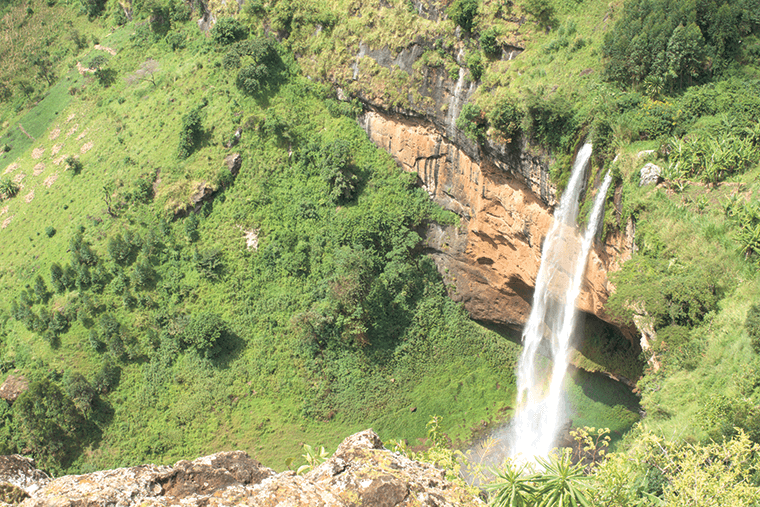
The Sipi Falls are just 55 kilometers from Mbale along a well-maintained road in the little market town of Sipi, which is situated at a height of 1,775 meters on the northeastern foot slopes of the mountain Elgon.
The settlement looks out into the 99-meter-high Sipi Falls. the third and final waterfall the Sipi River creates a beautiful splash as it crashes downhill from Mount Elgon’s upper slopes into the Kyoga Basin.
Visitors can engage in a variety of activities close to Sipi Falls, including abseiling, hiking, bird viewing, cave expeditions, cave painting trips, and camping. Views of the Karamoja plains, Lake Kyoga, and Mount Elgon’s flanks can be seen on hikes that travel around the falls.
Through the Uganda Wildlife Authority or regional private tour operators, people can arrange vacations.
The footpaths and caves that surround the falls provide hiking opportunities, viewing the extensive banana and coffee plantations that surround the waterways, and interacting with the local Bagisu and Sabiny people.
Itanda Falls

The Bujagali Falls were replaced by the Itanda Falls in Jinja, which is located in Eastern Uganda along the Nile River. Itanda Falls is about 30 kilometers off Jinja Road, and it takes about 45 minutes to travel there on a clean road.
The waterfalls are revered by the locals as holy sites; those who live on the slopes typically travel to the base of the tree in search of a visible blessing during trying times
The Itanda Falls is currently one of Jinja’s most popular tourist attractions; the river’s history, as well as the area’s views and sounds, make it a must-see on any intriguing safari tour of Uganda.
Aruu Falls
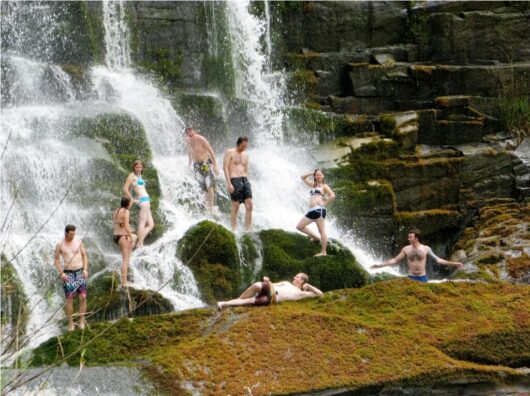
The water comes from a river that runs through the Agago River and comes from both the Agago and Pader districts.
The exhilarating, fascinating, and daring Aruu Falls are flowing torrents of thundering waterfalls.
The Aruu waterfalls are especially stunning because of their jarring, crashing descent. Watching the water cascade down the rocks at the waterfalls is a highly colorful sight.
This is the perfect location for thrill-seekers because you can take a bath under the waterfalls. Additionally, getting there on your own is an adventure in itself due to the ragged rocks and poorly defined trail that must be navigated.
On the Gulu-Kitgum route, Aruu Falls is situated in Northern Uganda, 386 kilometers from Kampala, the country’s capital city, and 47 kilometers from Gulu.
Bwindi Water Falls

In addition to mountain gorilla trekking, Bwindi Impenetrable National Park’s Buhoma section and Rushaga area contain two significant waterfalls.
The waterfalls are the pinnacle of Uganda’s wild experiences; the sights and sounds of this jewel of the tropics of Africa are all condensed in and around these falls.
Mountain Gorilla sightings are quite uncommon near the falls, but your journey to the falls in Bwindi Impenetrable National Park will allow you to see a wide variety of birds.
Murchison Falls

A very stunning sight, the Victoria Nile rushes down a 43-m-long gorge before plunging into a turbulent frothy pool at the bottom.
Murchison Falls is a power of nature and the most visited waterfall in Uganda. It is located in the northwest, between Lake Kyoga and Lake Albert, in Uganda’s largest national park.
Taking a boat tour or going on a guided hike are the two finest ways to see Murchison Falls. You can feel the force of the cascade increasing as you go closer to the falls via boat.
Karuma Falls
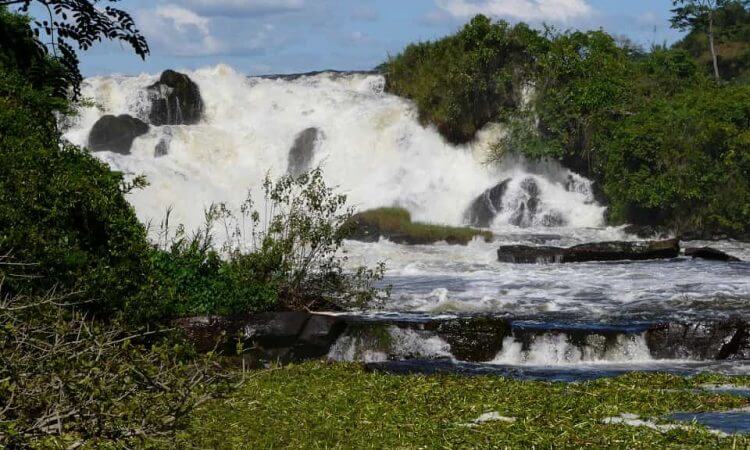
Karuma Falls, located on the Victoria Albertine Nile in Uganda, are the most stunning waterfalls; one would be unable to stop admiring them for their breathtaking scenery and impressive appearance.
The largest national park in Uganda, Murchison Falls National Park, contains Karuma Falls in its easternmost region.
The origin of name Karuma derives from the legend that the Victoria Nile River was blocked from flowing by the Great Spirit Karuma, who also gave the name to the falls in Karuma.
Mahoma Water Falls

Wondering where you would spend your time while in Fort Portal? Take a drive to Mahoma Falls in Kasenda. Enjoy the beautiful site, scenery of the falls and the surrounding area, as well as best weather and pristine nature of this village.
The Mahoma Falls is located in a serene, lovely, and yet incredibly gorgeous location of Kasenda, in Kabarole near Fort Portal Tourism City of Western Uganda.
The Mahoma falls are set up in a very peaceful, beautiful and yet very scenic area of Ruteete characterized with cool temperatures and within a walking distance
Suggested duration
The mahoma falls are set up in a very peaceful, beautiful and yet very scenic area of Kasenda characterized with cool temperatures and within a walking distance from Ndali lodge and next to Lake Mwamba Safari Lodge.
The water falls formed as a result of River Mahoma (which was formed due to major volcanic activity believed to have taken place during the middle Holocene, between 4000 and 6000 BC) flowing over some boulders into a forested valley with a rocky surface that allows the water to flow over them with a refreshing splash as it cascades with a plunge pool where one can take a bracing dip.
The falls have now become a major tourism attraction in Fort Portal area where travelers have found it much more interesting and a sight not to be missed once in Fort Portal. Visitors to the Mahoma falls are rewarded with refreshing views of the water falls stumbling over the rocks with a gush, a lush green environment, an impressive birdlife, beautiful rocks, a serene, peaceful and cool atmosphere. You may also choose to spend some time in Fort Portal town as you enjoy chicken, cream of mushroom sauce with mashed potatoes, at Café Azivia, in the heart of Fort Portal Tourism City. Don’t miss on this ultimate experience.
Visitors to Mahoma Falls are rewarded with the energizing sights of the waterfalls gushing over the rocks with a splash, a lush green landscape, astonishing birdlife, stunning rocks, and a tranquil, peaceful, and cool ambiance.
Enjoy an eco-friendly nature walk/hike to the scenic and spectacular Mahoma falls where you can take a power shower at the falls. With its picturesque quality, the falls give an awesome backdrop that will be the setting for impressive photography and even more epic memories.
After a brisk two-hour walk, visiting at least three crater lakes, standing under the splashing cool waters of Mahoma Falls is welcome and refreshing.
The Mahoma Falls tour is incredible and not to be missed – from views of the crater lakes as you walk through homesteads or the sounds of the water falling and splashing onto the rocks below, to the feel of the water falling hard on your back – providing an “African Hydrotherapy Massage”. This tour offers an unforgettable experience of Fort Portal, and its crater lakes.
Ssezibwa Falls

Historically, culturally, and religiously, the Ssezibwa Falls are important to Buganda. PHOTO/TRIPADVISOR
Along the main route connecting Kampala and Jinja in the District of Mukono, Ssezibwa Falls is situated 32 kilometers from Kampala city.
Water rushes through a small opening in some rocks and plunges quickly (17 meters) into a sizable pool that is roughly 14 meters deep. This is what causes the Ssezibwa falls.
One of the greatest spots to unwind after a lengthy wildlife safari in Uganda or before going to the source of the Nile river for sports like whitewater rafting or bungee jumping is the region around the falls.
Local slang for “something infinite” refers to the term Ssezibwa. Another significant cultural and spiritual location for the Baganda people is the Sezibwa Falls.
Kisiizi Falls

The Kisiizi Falls are just a few hundred meters from Kisiizi Hospital on the Kyabamba River.
The stunning Kisiizi Falls are located in the Rukungiri district, which borders Kabale and is in the southwest corner of Uganda, just a few meters from Kisiizi Hospital, on the Kyabamba River.
These falls, which pour water into a valley to continue the River’s flow, are roughly 27 meters high. Visitors to the Kisiizi Falls are greeted by mist from the falls at a distance of at least 100 meters, letting them know that they are approaching the stunning site with a dark cultural past.
The older residents of this area claim that these falls are to blame for the decent morals of the unmarried Bakiga girls in the neighborhood.
When a girl became pregnant outside of marriage, her father and brother would accompany her to the top of these falls before releasing her to plunge down the cliff and perish.
This was done to deter other females from having premarital s#x, which frequently results in pregnancy. It was to ensure that girls remained virgins until marriage.
Mpanga Falls
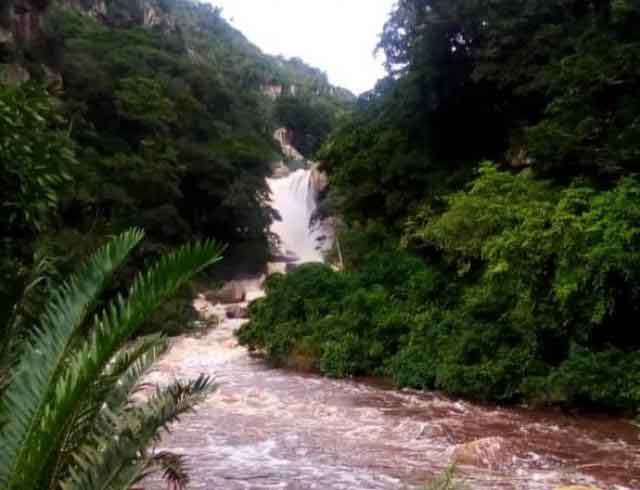
The Mpanga River, which contains the falls, feeds Lake George and gives them their shape and beauty.
It rushes towards the lake through a sizable gap in the eastern cliff of the rift valley and also through a rocky chasm of unusual spray forest of cycad, a species unique to Mpanga Gorge, to the impressive Mpanga Falls. The gorge surrounds the falls, which in turn supports the luxuriant spray forest.
The falls are surrounded with numerous cycad plants, one of the endemic plants in Uganda. In Uganda, cycad plants are in Kitagwenda District in the Mpanga Gorge, a very scenic area near Queen Elizabeth Park. The Mpanga Gorge Trail is closest to other Tourist destinations in Western Uganda, such as Kibale Forest and Queen Elizabeth Park.

Conclusion
It is said that you can’t help but feel happy when in the presence of waterfalls. This statement is true about the Uganda waterfalls. They aren’t an everyday geographical feature that can be found everywhere. These waterfalls are unique to this particular country. Many tourists can’t help but travel to Uganda to see the best waterfalls. The famous Itanda Falls, Sipi Falls, and Murchison Falls offer some of the most breathtaking views, perfect for pictures and picnics. These should be on your list of things to see when you visit Uganda. Contact us to plan your Waterfall safari to Uganda simply by a call or whatsaap at +256392156562 or send an email to kitararcc@gmail.com or kitara.ktcnet@gmail.com

 COMMUNITY BASED TOURISM DEVELOPMENT AT KITARA FOUNDATION FOR SUSTAINABLE TOURISM: Transforming Communities through Travel Partnerships. Email: kitararcc@gmail.com;