Unveiling the Cradle of Kings and Heartbeat of Nature
Long before modern borders carved up East Africa, there existed a legendary empire whose influence echoed across the African Great Lakes region: Bunyoro-Kitara. Today, the name Kitara refers to the vibrant geographic, historical, and cultural landscape of western Uganda. Spanning mist-shrouded crater lakes, snow-capped mountain ranges, prehistoric flora, thermal geysers, roaring waterfalls, and dense rainforests, Kitara is a realm where deep-rooted tradition and natural wonders meet.
Here is what makes Kitara one of the most intriguing, cultural and nature-rich, and geographically unique destinations on the African continent.
The Area of Kitara: Where History Meets Geography
Historically, the Empire of Kitara stretched across vast swathes of Uganda, Rwanda, Burundi, eastern Democratic Republic of Congo, and northwestern Tanzania under the leadership of the mythical Batembuzi and Bachwezi dynasties.
Today, the modern heartland of Kitara encompasses western and southwestern Uganda, anchored by key historical hubs such as Hoima (the royal seat of Bunyoro), Fort Portal (the clean, scenic eco-tourism capital under the shadow of the Rwenzori Mountains), and the rolling highlands of Kigezi and Ankole.
The geography of Kitara is defined by dramatic landscape contrasts:
- The Equator Line: The zero-degree latitude cuts directly through Kitara in Queen Elizabeth National Park and Kasese, offering travelers the experience of standing in both the Northern and Southern Hemispheres simultaneously.
- The Albertine Rift: The western arm of the Great Rift Valley, framing magnificent lakes like Lake Albert, Lake George, and Lake Edward.
- Crater Lakes District: Over 50 emerald-green volcanic explosion crater lakes scattered across Ndali-Kasenda, Fort Portal, and Bunyaruguru.
- Highland Ridges: Terraced emerald hillsides that yield coffee, tea, matooke (plantains), and fresh produce.
The People of Kitara: Warmth, Resilience, and Heritage
To know Kitara is to know its people. The region is home to several closely related Bantu ethnic groups, collectively bound by shared linguistic roots, history, and customs. Among them are the Banyoro, Batooro, Banyankole, Bakiga, Batagwenda, Babwiisi, Bamba, Bafumbira and Bakonzo.
The people of Kitara are renowned across East Africa for their gentle demeanor, hospitality, and profound respect for ancestral tradition. Historically divided into pastoralists (Abahiima) and agriculturalists (Abairu), modern Kitara communities live in close harmony, keeping their oral histories alive through storytelling, proverbs, and traditional royalty.
A central element of personal identity in Kitara is the Empaako system—a traditional naming tradition recognized by UNESCO as intangible cultural heritage. Alongside their birth names, individuals are given one of thirteen pet names (such as Abooki, Akiiki, Araali, or Abwooli) as a token of respect, affection, and social cohesion.
The Regal Ankole Long-Horned Cattle
No cultural icon represents Kitara’s pastoral identity quite like the Ankole Long-Horned Cattle. Reared for centuries by the pastoral communities of Ankole, Bunyoro, and Tooro, these majestic animals are famed for their massive, snow-white, lyre-shaped horns that can measure up to 8 feet from tip to tip.
Far more than livestock, these cattle are living symbols of beauty, status, and heritage:
- Social Significance: Historically used as dowry, royal gifts, and measures of wealth.
- Cultural Connection: Herders compose poetry (Ebyevugo) and specific singing whistles to praise individual cows, recognizing each animal by its coat color, horn shape, and temperament.
- Therapeutic Produce: Their rich milk is transformed into Eshabwe, a prized delicacy served at major cultural milestones and royal banquets.
The Cultures of Kitara: Kings, Music, and Sacred Rites
The cultural fabric of Kitara is anchored in its living kingdoms—most notably Bunyoro-Kitara Kingdom and Tooro Kingdom. These monarchies preserve century-old rituals, court music, and ancestral wisdom.
- Traditional Dances: The region comes alive through rhythmic folk music and dance. The energetic Runyege-Entogoro dance of the Banyoro and Batooro—characterized by energetic footwork and the rattling of leg-bound pods—tells stories of courtship and bravery. To the south, the Ekitaguriro dance of Ankole mirrors the graceful movements and sweeping horn shapes of the Ankole cattle.
- Cuisine: Food in Kitara is deeply connected to the land and livestock. Staples include Eshabwe (a rich, clarified butter sauce served at ceremonies), Firinda (mashed seasoned beans cooked without skins), Matooke (steamed plantains), and millet bread (Kalo).
- Craftsmanship: Artisans excel in hand-woven raffia baskets, barkcloth making, wood carvings, and traditional pottery, skills passed down across generations.
The Natural Environment: Mountains, Rare Flora, and Waters
Kitara boasts some of the highest biodiversity densities, rarest evolutionary plant species, and most impressive physical landmarks on Earth.
Prehistoric & Emblematic Plants of Kitara
Kitara’s unique ecosystems foster extraordinary botanical specimens found nowhere else in such abundance:
- The Mpanga Cycad (Encephalartos whitelockii): A primitive, cone-bearing palm-like plant endemic to the Mpanga River Gorge in Kitara. Growing along steep granite cliffs and spray zones of river waterfalls, these botanical “living fossils” survived from the Jurassic era, existing virtually unchanged for over 200 million years.
- The Borassus Palm (Borassus aethiopum): Towering above the savannas of northern Kitara—particularly across Murchison Falls National Park and the Lake Albert flats—the giant African fan palm dominates the landscape. Growing up to 30 meters tall with swollen, bulbous trunks, these iconic trees provide vital habitat for wildlife, while elephants feed eagerly on their aromatic, melon-sized yellow fruits, dispersing seeds across the landscape.
The Majestic Mountains of Kitara
Dominating Kitara’s skyline are dramatically varied mountain ranges that dictate the region’s climate, rivers, and ecosystems:
- The Rwenzori Mountains (“Mountains of the Moon”): Rising along the edge of the Albertine Rift, the Rwenzori mountain range peaks at Mount Stanley (5,109 meters/16,762 feet—Africa’s third-highest peak). Unlike Kilimanjaro or Mount Kenya, the Rwenzoris are a non-volcanic tectonic uplift featuring equatorial glaciers, alpine lakes, giant lobelias, and misty moss-draped forests.
- The Virunga Volcanoes: To the far south of Kitara stand the dramatic volcanic cones of Mount Muhabura, Mount Gahinga, and Mount Sabyinyo within Mgahinga Gorilla National Park, creating a jagged, mist-covered border.
- Kigezi & Ankole Highlands: Rolling green ridges often dubbed the “Switzerland of Africa,” covered in terraced farms and deep valleys.
Geothermal Springs, Waterfalls, Lakes, and Rivers
Kitara’s rift-valley geology has gifted the region with extraordinary water features that carry both ecological importance and deep cultural lore:
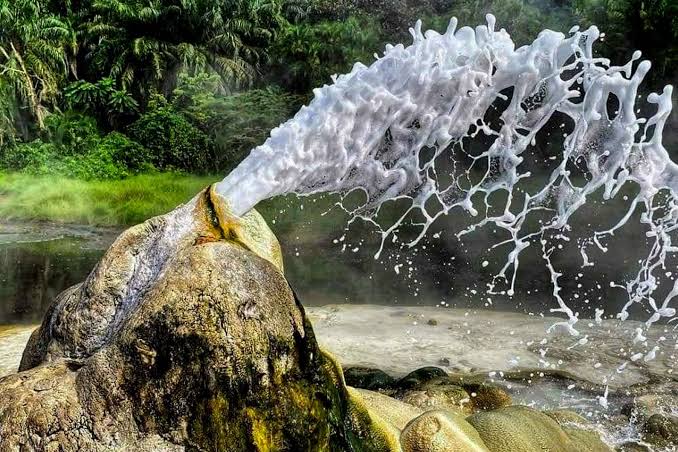
- Geothermal Hot Springs: The famous Sempaya Hot Springs in Semuliki Valley boil at over 103°C, spewing high-pressure steam and mineral water through tropical rainforest floor. Other key thermal sites include the Kitagata Hot Springs in Ankole (revered for therapeutic healing) and the Kilembe hot springs.
- Lakes of the Rift: Beyond the Great Lakes (Albert, Edward, and George), Kitara contains dozens of volcanic crater lakes like Lake Nyabikere, Lake Nkuruba, Lake Nyinambuga, Lake Mbuuro, Lake Bunyonyi, Lake Africa and the salty Lake Katwe, where traditional salt mining has been practiced for centuries.
- Legendary Waterfalls: The majestic Murchison Falls (Kabalega Falls) sees the entire Victoria Nile force itself through a tiny 7-meter gap before plunging 43 meters down. Hidden nearby, the Amabere Ga Nyinamwiru Waterfalls combine tumbling streams with stalactite caves steeped in Chwezi kingdom folklore, Rwenzori Mountains host majestic waterfalls such as Kiima falls, Ngite falls, Ssebwe falls, while Mpanga Falls cascades through wild forest gorges towards lake George.
- Lifeline Rivers: The Victoria Nile, Albert Nile, Semliki River, River Rwizi, Kagela river, Kazinga channel, Birira river, and Mpanga River weave through Kitara, providing life to surrounding communities, forests, and wildlife reserves.
Protected Parks & Reserves
Kitara region hosts over 70% of Uganda’s Tourism destinations and National parks hosting the giants such as the gorilla, chimpanzee, rhinos, hippos, elephants, giraffe, zebra, etc
| Protected Area | Defining Feature & Unique Ecosystems |
| Lake Mburo National Park | Kitara’s acacia savanna realm, famous for vast zebra herds, impalas, elands, leopards, night game drives, and peaceful boat safaris on Lake Mburo. |
| Semuliki National Park | A lowland Congo-basin tropical forest enclave featuring steaming geothermal Sempaya Hot Springs, Central African bird species, forest elephants, and indigenous Batwa heritage. |
| Kibale National Park | The “Primate Capital of the World,” framed by crater lake clusters and pristine swamp ecosystems. |
| Murchison Falls National Park | Dominated by Borassus palm savannas where the Nile plunges into a gorge, feeding elephant and hippo herds. |
| Rwenzori Mountains National Park | Snow-capped equatorial peaks, sourcing glacial rivers, alpine vegetation, and pristine mountain tarns. |
| Queen Elizabeth National Park | Bisected by the Equator line, famous for Kazinga Channel boat safaris, crater drives, and tree-climbing lions. |
| Bwindi Impenetrable Forest | A UNESCO World Heritage forest protecting mountain gorilla strongholds and high-altitude waterfalls. |
Experience Kitara
Whether you are admiring herds of long-horned Ankole cattle, straddling the Equator, standing under ancient Borassus palms and cycad glades, boiling eggs at Sempaya, or taking in sunset over a crater lake, Kitara offers an authentic journey into the soul of Africa.
Kitara is not merely a destination on a map—it is a living legacy, a story of royal empires, warm-hearted people, equatorial marvels, and untouched natural beauty waiting to be explored by the world.


